
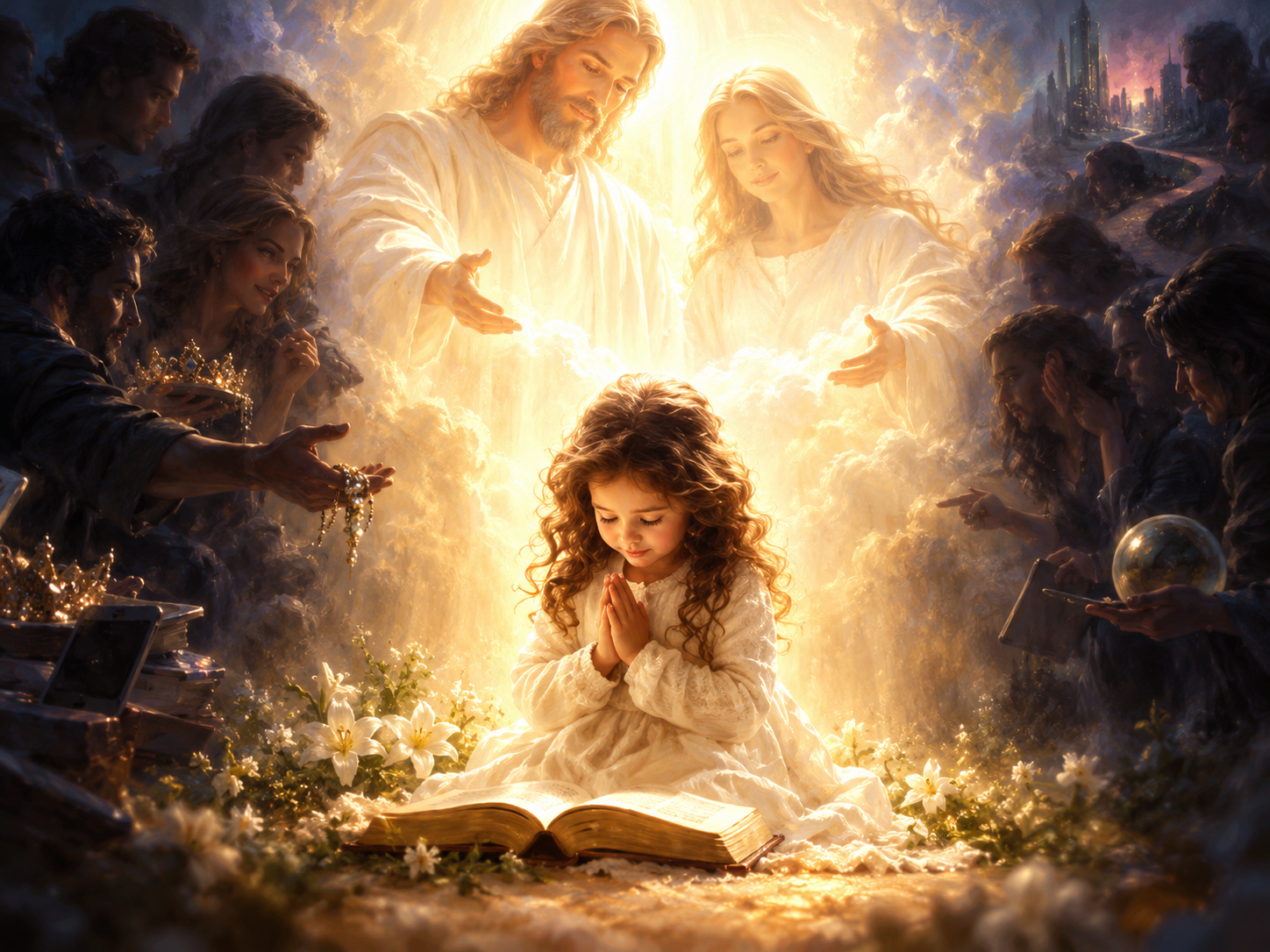
A Daughter’s Question — Heavenly Mother and the Prophets
For the Latter-day Saint woman who has known the Father and the Son all her life and now wants to know her Mother in Heaven, and her own place in the plan. What is settled, what was happening each time the prophets restated the line, and where each path has led.
This series
- Heavenly Mother — the doctrine
- A Daughter’s Question — the history, and why the prophets hold the line
- Questions About Who She Is — Her role, plural marriage, origins, worship and prayer
- Questions from Her Daughters — silence, revelation, a woman’s place, and what we owe each other
The Question
In 1991 a fourteen-year-old girl wrote to the President of the Church. “If we are all Heavenly Father’s children, then why do the scriptures say that men are to rule over women?… are men more important than women? And can women go to the celestial kingdom also?” President Gordon B. Hinckley read her letter aloud to the women of the Church and answered it (“Daughters of God”). Her question has not gone away.
Many Latter-day Saint women believe in Her and seldom think of Her; the doctrine is accepted and then set aside. Others feel drawn to Her — some since girlhood, some when they first carry a child, some in a quiet moment of the Spirit — and they want to KNOW Her. For some of those women the distance between how firmly the Church affirms Her and how rarely She is spoken of has turned into a crisis of faith.
Is that longing wrong? No. A daughter who wants to know her Mother is doing what a daughter should. The real question is where the answer comes from — and the last forty-five years show plainly what happens down each road.
What Is Settled
The doctrine of Heavenly Mother is not a mystery. It is a given, and the Church has said so in its most authoritative voice:
The Family: A Proclamation to the World (1995)
“All human beings—male and female—are created in the image of God. Each is a beloved spirit son or daughter of heavenly parents, and, as such, each has a divine nature and destiny.”
The First Presidency taught it in 1909: “All men and women are in the similitude of the universal Father and Mother, and are literally the sons and daughters of Deity” (“The Origin of Man”). President Hinckley, in the same 1991 talk in which he asked members not to pray to Her, said: “Logic and reason would certainly suggest that if we have a Father in Heaven, we have a Mother in Heaven. That doctrine rests well with me.” The Church calls it “a cherished and distinctive belief among Latter-day Saints” (Gospel Topics essay), and teaches that “although we do not worship Her, we honor Her as a divine parent” (“Heavenly Parents”).
What has NOT been revealed is detail — Her attributes, Her work, how She is known. Elder Dale G. Renlund was candid about it in 2022: “Very little has been revealed about Mother in Heaven… Once you have read what is there, you will know everything that I know about the subject. I wish I knew more” (“Your Divine Nature and Eternal Destiny”). An apostle who says “I wish I knew more” is not hiding anything.
So why has a settled doctrine produced so much conflict? Because a doctrine with few revealed details has room in it, and room is exactly what others have tried to fill. Take a truth that is certain but sparsely described, and it becomes the perfect pet doctrine — anyone can pour into it whatever they wish it said, and then hold up the result as the thing the Church is hiding.
What Was Happening Each Time
The statements people remember — “we know only what has been revealed,” “we do not pray to Her” — were never made in a vacuum. Each one answered something that was already moving:
| Year | What was happening | What the prophets said |
|---|---|---|
| 1979 | A co-founder of a pro-ERA advocacy group is questioned by her bishop about “her part in a possible ‘Mother in Heaven’ cult.” She is excommunicated in December. | — |
| 1984 | The RLDS Church (now Community of Christ) votes to ordain women. About 25,000 members leave for independent branches within ten years. | — |
| 1991 | Prayers to Mother in Heaven spread among some Latter-day Saint feminists. | Hinckley, April, to Regional Representatives: praying to Her is “inappropriate.” A copy leaks and circulates as if it were secret. In September he reads it to the women of the Church: “There is nothing secret or hidden.” |
| 1992 | A feminist anthology reprints the Mother in Heaven essays beside an argument that endowed women have held the Melchizedek Priesthood since 1843. | — |
| 1993 | A BYU professor tells a symposium she will not “forget or deny” Mother in Heaven, and later prays to Her in public. In September six writers are disciplined, among them the president of a Mormon women’s forum who spoke on Mother in Heaven. In November a Minneapolis conference of mainline churches prays, “Sophia, we celebrate the nourishment of your milk and honey.” | Packer, May, to Church leaders: the feminist movement is one of three areas where members “are being caught up and led away.” Packer, October: “Gender existed before, and did not begin at mortal birth.” |
| 1994–95 | A published theology of God the Mother names Her as the Holy Ghost and says “we certainly may address her directly in our prayers.” Its author is excommunicated in 1995; a second paper of hers disputed that the Lord “will never let any man or group of men lead [the Church] astray.” | The Proclamation, September 1995: “Gender is an essential characteristic of individual premortal, mortal, and eternal identity and purpose.” |
| 2010 | The Community of Christ World Conference opens the door to same-sex marriage; the U.S. church adopts it in 2014. | Oaks warns of members who “go their own way, purporting to define doctrine and to direct competing organizations.” |
| 2013–14 | An organization is founded to press for women’s ordination. Members seek entry to the priesthood session in October 2013 and April 2014, and the founder is excommunicated that June. Meanwhile 90% of Latter-day Saint women tell Pew that women should NOT be ordained. | Ballard, 2013: endowed men and women receive “the same power, which by definition is priesthood power.” Oaks, 2014: women set apart in callings exercise priesthood authority. |
| 2015 | — | Gospel Topics essays on Mother in Heaven and on women and priesthood. Nelson: “We need women with the gift of discernment who can view the trends in the world and detect those that, however popular, are shallow or dangerous.” |
| 2019 | — | Nelson: endowed women receive “a gift of God’s priesthood power.” |
| 2022 | Online argument over Heavenly Mother reaches a public summit in Provo. | Renlund: the doctrine “comes by revelation”; we “do not pray to Heavenly Mother”; “Reason cannot replace revelation.” |
Why the Line Is Drawn at Prayer
Why not simply let a woman pray to her Mother? Because prayer is where revelation is received, and the question underneath many of these disputes became who speaks for God.
The pattern was set by the Savior Himself: “ye must always pray unto the Father in my name” (3 Nephi 18:19–21; Matthew 6:9). President Hinckley searched for an exception and found none: “I find nowhere in the standard works an account where Jesus prayed other than to His Father in Heaven or where He instructed the people to pray other than to His Father in Heaven.” Then he described how the new practice had actually spread — it “began in private prayer and is beginning to spread to prayers offered in some of our meetings.” A form of worship no one with keys had authorized was on its way into the congregation.
The Church had met that shape before, in its first year. Hiram Page produced revelations through a stone of his own, and several members believed them. The Lord’s answer was not about the stone:
“And this shall be a law unto you, that ye receive not the teachings of any that shall come before you as revelations or commandments; and this I give unto you that you may not be deceived, that you may know they are not of me.”
See also D&C 28:2, 11–12. And the prophets are bound by the same law. Elder Renlund used Balaam to make the point — “I cannot go beyond the word of the Lord my God, to do less or more” (Numbers 22:18) — and added: “Latter-day prophets are similarly constrained. Demanding revelation from God is both arrogant and unproductive.” The leaders were refusing to invent a Heavenly Mother doctrine for the same reason they refused to accept one invented by anyone else.
Look at what the new theologies actually did. Were they content to honor Her? They were not. One declared that She is the Holy Ghost, which rewrites the Godhead; the same author disputed that the Lord would never let the Church’s leaders lead it astray, which removes the one guard that could have corrected her. The 1992 anthology set Mother in Heaven beside an argument for women’s ordination. Heavenly Mother had become a lever — pull on Her, and the priesthood, the Godhead, and the authority of the prophets were all supposed to move. A doctrine used to move something else is no longer being received. It is being handled.
The Questions Women Ask
Does She have a role? Is there one Mother or many? Why can we not pray to Her, and how do we know Her without it? Who may receive revelation about Her? Where does a woman who is single, childless, or hurting fit? Each of those questions deserves a real answer from what has been revealed, and each has one — more than fit on a single page.
Read the answers
- Questions About Who She Is — Her role, one Mother or many, where the doctrine came from, who She is not, worship and prayer
- Questions from Her Daughters — why She seems hidden, asking and who answers, a daughter’s place, what we owe each other
Where the Other Road Led
The record is public, and it is fair to let it speak in the words of those who walked it. No names are needed. The paths matter more than the people, and every one of them is a child of the same heavenly parents.
The co-founder questioned in 1979 about a “Mother in Heaven” cult spent the following decades in women-only separatism. In 2019, at 82, she told the Salt Lake Tribune: “What did I believe really? Did I believe in God? The answer was no.” She had begun, decades earlier, by seeking a Mother in Heaven outside the Church’s channel. By her own account, she ended without God.
Ten years after 1993, the forum president disciplined that September said, “I exploded out of the church and my marriage and onto a very different path” — a path her family later described as Native American ceremony and life coaching. Another of the six said, “I lost my faith. I didn’t renounce it.” A third listed where her own search had carried her: “from Catholic to Methodist to Episcopalian to pagan to shamanic to kabbalist to gnostic.” The 2014 founder called her excommunication “a gift… it set me free,” and added that “freedom of religion includes freedom from religion.”
Churches that took the road as institutions tell the same story in numbers. The RLDS Church ordained women in 1984, lost an estimated 25,000 members to breakaway branches within ten years, and by 2014 had moved on to same-sex marriage in the United States; its tithe-paying households in the U.S. and Canada have halved in a decade. The Episcopal Church, which ordained women in 1976, saw Sunday attendance fall 43% between 2013 and 2022. Do those numbers prove the changes caused the decline? No. They do prove the changes did not prevent it — and in every case the first step was not the last one.
And the road back? It is open, and it runs through Christ. The anthology’s editor, one of the six, was rebaptized in 2012. What was she asked? “Nobody asked me to disavow my book or stop writing. All they asked me about was my relationship to Jesus Christ.” Two others of the six have since been restored to membership as well, one of them after her death. The door was never locked.
They Saw It Coming
The statements answered what had happened. Read them against what came AFTER.
Warned, then fulfilled
- 1991 — Hinckley saw a practice that “began in private prayer” spreading, led by “a few who evidently are seeking to lead others in the paths which they are following.” Within three years a published theology said we “certainly may” pray to Her, and made Her the Holy Ghost.
- 1993 — Packer, of the woman drawn into the movement: “She will find no enduring peace in the feminist movement. There she will have no hope.” Twenty-six years later, a founder of the first of those campaigns answered the question of God with “no.”
- 1995 — The Proclamation fixed gender as eternal identity, two decades before “what is a woman?” became a public argument.
- 2010 — Oaks warned of members who would “direct competing organizations.” An organization to press for ordination was founded in 2013.
- 2015 — Nelson asked for women who can detect trends that are “however popular… shallow or dangerous.” Wicca had grown from about 8,000 American adherents in 1990 to 342,000 in 2008, and by 2019 a Sunstone session featured former Latter-day Saints describing “their journeys from being Mormons to being witches.”
- Today — Pew data put retention of Latter-day Saint women aged 18–49 at 49%, and among women who leave, “the role of women in the Church” ranks third of thirty reasons. The warnings were for THIS generation.
Did the leaders know in 1991 where these roads would end? They knew the pattern, which is what prophets are for. A church where anyone may reveal new doctrine about God soon has as many Gods as it has revelators, and a daughter who follows the newest one is led further from her heavenly parents with every step, however lovingly the road is paved. The line at prayer was never a wall between women and their Mother. It was the guard rail on the only road that leads to Her.
Where the Longing Leads
Where does the longing for Heavenly Mother lead, when it is followed faithfully? To Christ first, for “no man cometh unto the Father, but by me” (John 14:6), and the Father is not alone. The covenant path does not go around Her. It ends in the presence of our heavenly parents. Exaltation is the fulness of what They are, and it is given to a man and a woman together (D&C 131:1–4; 132:19–20). The Church says it in one sentence: “Men and women cannot be exalted without each other.”
So what is a daughter of God to do with the longing? Keep it. Honor Her, as the prophets do. Pray to the Father in the name of the Son, as the Son commanded. Go to the temple and receive the power the prophets have promised you. Test every new teaching about Her against the rule the Lord gave in 1831, so that you “may not be deceived.” And keep your covenants, not as a performance but as the relationship itself, for the Savior defined it that way: “If ye love me, keep my commandments” (John 14:15). Then become like Her, for that is Their goal for you as much as yours.
The doctrine is clear. The implications are clear. What is not clear is the private theology of anyone without the keys to receive it — and the last forty-five years have shown, in their own words, where that theology leads. The prophets refused to guess about your Mother. That refusal is how you will know that when they do speak of Her, it will be Her.
Key References
- Acts 17:28–29 — “we are the offspring of God”
- Hebrews 12:9 — “the Father of spirits”
- 3 Nephi 18:19–21 — “ye must always pray unto the Father in my name”
- D&C 28:2, 11–12 — revelation for the Church comes through the one appointed
- D&C 43:3–6 — “that you may not be deceived”
- Numbers 22:18 — “I cannot go beyond the word of the Lord”
- D&C 131:1–4 — the highest glory requires the covenant of marriage
- Moroni 7:16–17 — the test of every spiritual experience
- 1 Peter 3:15 — “be ready always to give an answer”
- D&C 18:40 — “worship the Father in my name”
- 1 Corinthians 8:5–6 — “to us there is but one God, the Father”
- 1 Nephi 11:21–22 — the tree is “the love of God”
- D&C 21:4–5 — the prophet’s word received “in all patience and faith”
- John 14:6 — no one comes to the Father but by Christ
- See also Heavenly Mother, The Priesthood Today, and The Framework of Revelation.
Sources
Every quotation on this page was checked against the document linked here. The Packer 1993 coordinating-council text was never published by the Church and is cited as circulated.
Church sources
- Gordon B. Hinckley, “Daughters of God,” General Women’s Meeting, September 28, 1991 (Ensign, Nov. 1991)
- Dale G. Renlund, “Your Divine Nature and Eternal Destiny,” April 2022
- “The Family: A Proclamation to the World,” September 23, 1995
- First Presidency, “The Origin of Man,” November 1909
- Gospel Topics essay, “Mother in Heaven,” October 2015
- Gospel Topics essay, “Joseph Smith’s Teachings about Priesthood, Temple, and Women,” October 2015
- Official Declaration 2 (1978)
- Dallin H. Oaks, “Apostasy and Restoration,” April 1995
- Young Women theme
- Aaronic Priesthood quorum theme
- Topics and Questions, “Heavenly Parents”
- Boyd K. Packer, “For Time and All Eternity,” October 1993
- Boyd K. Packer, talk to the All-Church Coordinating Council, May 18, 1993 (text as circulated; not published by the Church)
- Dallin H. Oaks, “Two Lines of Communication,” October 2010
- Dallin H. Oaks, “The Keys and Authority of the Priesthood,” April 2014
- M. Russell Ballard, “Let Us Think Straight,” BYU Education Week, August 20, 2013
- M. Russell Ballard, “Return and Receive,” April 2017
- Russell M. Nelson, “A Plea to My Sisters,” October 2015
- Russell M. Nelson, “Spiritual Treasures,” October 2019
- Spencer W. Kimball, “The True Way of Life and Salvation,” April 1978
- Wilford Woodruff, discourse of October 8, 1893, Millennial Star 56:229 (April 9, 1894)
- Church Newsroom, release of the Mother in Heaven and priesthood essays, October 23, 2015
History and reporting
- David L. Paulsen and Martin Pulido, “A Mother There,” BYU Studies 50:1 (2011)
- Daniel C. Peterson, “Nephi and His Asherah,” Journal of Book of Mormon Studies 9:2 (2000)
- Dialogue 14:2 (1981), review recounting the 1979 “Mother in Heaven” cult questioning
- University of Utah, Marriott Library finding aid (1979 excommunication date)
- RLDS Doctrine and Covenants Section 156 (April 1984)
- Sunstone news, August 1992
- Deseret News, May 11, 1995
- Religion News Service, July 6, 1996
- Christianity Today, April 4, 1994, on the Re-Imagining conference
- Salt Lake Tribune, August 16, 2003, ten-year panel (reprint)
- Salt Lake Tribune, July 26, 2012, on the 2012 rebaptism
- KSL, October 2013, priesthood-session protest and Church statement
- Deseret News, March 17, 2014, Church letter on ordination
- Glamour, May 6, 2020
- Salt Lake Tribune, January 18, 2019
- Salt Lake Tribune, July 17, 2025
- Sunstone podcast E124 (2019 Symposium session)
Data
- Pew Research Center, October 8, 2013 (2011 survey: 90% of LDS women oppose ordination)
- Next Mormons Survey, reported by Religion News Service, November 26, 2018
- Religion News Service, August 4, 2026 (retention from Pew Religious Landscape Study)
- U.S. Census Bureau, Statistical Abstract 2012, Table 75 (ARIS data)
- Times & Seasons, March 2024, Community of Christ figures
- Episcopal News Service, September 21, 2023