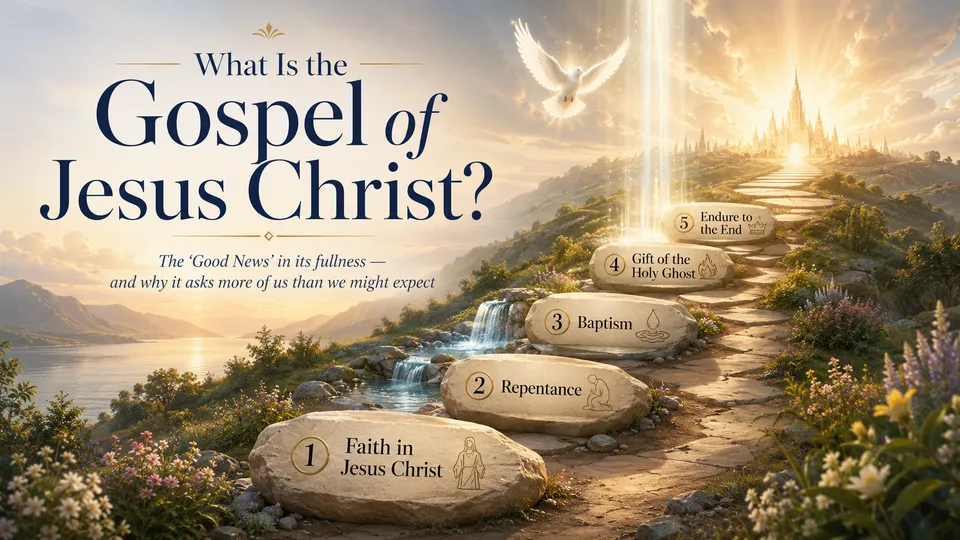
What Is the Gospel of Jesus Christ?
The “Good News” in its fullness — and why it asks more of us than we might expect
What Does “Gospel” Actually Mean?
The English word gospel comes from the Old English gōdspel — itself a translation of the Greek euangelion, meaning good news. Every Christian tradition celebrates this good news. But what exactly is it? Good news about what — and on what terms?
In many Protestant traditions, the gospel has been simplified to a single proposition: believe in Jesus Christ and you are saved. This is a beautiful truth. It is also incomplete. The gospel Jesus proclaimed was not a simple formula. It was an invitation into a covenant relationship with God — with very specific terms He Himself laid out.
Consider the very first recorded proclamation of the gospel in Mark’s account. When Jesus began His ministry, He did not simply say “believe.” He said:
“The time is fulfilled, and the kingdom of God is at hand: repent ye, and believe the gospel.”
Repent, and believe. Both. The gospel, from Christ’s own lips, is not passive acceptance — it is an active turning toward God. Latter-day Saints understand the gospel in its fullness: God’s eternal plan for the salvation and exaltation of His children, centered on the Atonement of Jesus Christ, and comprising specific principles and ordinances that together make transformation possible.
What Jesus Said the Gospel Requires
To understand what the gospel demands, we must go to Jesus Christ Himself — not to any tradition that came after Him. And what He taught, consistently and repeatedly, was that salvation involves both trust in Him and transformation through Him.
Many Christians quote John 3:16 as the gospel in full — and rightly so; it is one of scripture’s most glorious verses. But the same conversation with Nicodemus included this equally direct teaching from the same lips:
“Verily, verily, I say unto thee, Except a man be born of water and of the Spirit, he cannot enter into the kingdom of God.”
Born of water and of the Spirit. The New Testament consistently connects this to baptism and the gift of the Holy Ghost — as Peter made explicit on the day of Pentecost (Acts 2:38). Jesus also taught plainly that discipleship has substance:
“Not every one that saith unto me, Lord, Lord, shall enter into the kingdom of heaven; but he that doeth the will of my Father which is in heaven.”
He that doeth the will of my Father. A gospel that asks nothing of us ultimately offers us nothing — because transformation requires participation. The Latter-day Saint understanding does not diminish Christ. It takes Him at His word.
The Five Principles of the Gospel
The Book of Mormon prophet Nephi, writing centuries before Christ’s mortal ministry yet with prophetic clarity, described the doctrine of Christ in terms that align precisely with the New Testament pattern Peter established at Pentecost:
“This is the way; and there is none other way nor name given under heaven whereby man can be saved in the kingdom of God. And now, behold, this is the doctrine of Christ.”
1. Faith in Jesus Christ
Faith is the foundation of everything. Not mere intellectual agreement with a creed — but trust deep enough to act upon. Hebrews 11:1 defines it as “the substance of things hoped for, the evidence of things not seen.” Faith that does not move us is not yet the faith the gospel requires (James 2:17). It is a living, active trust in the person and power of Jesus Christ. See: Faith.
2. Repentance
The Greek word for repentance — metanoia — means a complete change of mind and direction. It is not guilt management or emotional remorse alone; it is a genuine turning away from sin and toward God with the whole soul. The Atonement of Jesus Christ makes this transformation possible, granting forgiveness as we sincerely return to Him (Alma 34:31). See: Repentance.
3. Baptism by Immersion
Jesus Himself was baptized — not because He needed cleansing from sin, but to “fulfil all righteousness” and show us the way (Matthew 3:15). He then declared baptism essential for entering God’s kingdom (Mark 16:16; John 3:5). Paul describes it as a burial of the old self and a resurrection to newness of life — a covenant act perfectly suited to immersion (Romans 6:4). See: Baptism.
4. The Gift of the Holy Ghost
At Pentecost, Peter’s great sermon concluded with a precise invitation: “Repent, and be baptized every one of you in the name of Jesus Christ for the remission of sins, and ye shall receive the gift of the Holy Ghost” (Acts 2:38). This is not the occasional influence of the Spirit — it is a conferred, abiding presence: a constant companion who sanctifies, guides, and testifies of truth. See: The Holy Ghost.
5. Enduring to the End
The gospel is not a single moment of conversion. It is a lifelong walk. Jesus said “he that endureth to the end shall be saved” (Matthew 24:13). Enduring to the end means continuing to exercise faith, repent as needed, honor sacred covenants, and follow the Savior — not merely crossing a starting line, but running the full race to the finish (2 Nephi 31:20).
Grace and the Gospel: Is This Works-Based?
The most common Protestant concern about Latter-day Saint teaching is this: “You are adding works to grace.” It is a fair question, and it deserves a direct answer.
Latter-day Saints fully affirm that no one earns salvation through their own merit. The Atonement of Jesus Christ is the only source of forgiveness, the only power capable of raising us from death, and the only hope any of us has of standing before a holy God. Without Him, our best efforts are utterly insufficient. This is not a peripheral teaching — it is the very center of everything we believe.
What Latter-day Saints reject is the idea that genuine faith asks nothing of us. James — writing to Christian believers — declared unambiguously:
“Even so faith, if it hath not works, is dead, being alone… For as the body without the spirit is dead, so faith without works is dead also.”
The Book of Mormon states with striking precision what scripture everywhere confirms: “for we know that it is by grace that we are saved, after all we can do” (2 Nephi 25:23). Grace covers what we cannot do — which is everything beyond our reach. It does not replace what we can and must do. This is not a burden. It is the truth that makes both grace and human agency genuinely meaningful.
What Scripture Says About Grace and Works
Ephesians 2:8–10 — Saved by grace through faith — and created for good works, which God prepared in advance for us to walk in
James 2:17 — Faith without works is dead
Matthew 7:21 — Only those who do the Father’s will enter the kingdom of heaven
Revelation 20:12 — “The dead were judged… according to their works”
The Gospel and the Church
It is important to distinguish between the gospel and the Church. The gospel is God’s plan — eternal, unchanging, centered entirely on Christ. The Church of Jesus Christ of Latter-day Saints is the divinely organized institution through which the gospel’s saving ordinances are administered and its truths are taught to the world.
The Church is not the gospel. The ordinances of the gospel — baptism, the gift of the Holy Ghost, and others — require priesthood authority to be administered validly. This is why Paul described the Church’s structure as given for “the perfecting of the saints” and “the edifying of the body of Christ” (Ephesians 4:11–13). The ordinances of the priesthood “manifest the power of godliness” in our lives (Doctrine and Covenants 84:20).
The Church exists to help every individual access the transforming power of the Atonement through proper covenant-making — not as an end in itself, but as God’s appointed means of delivering the gospel to every soul who has ever lived or will live on this earth.
The Gospel as a Living Journey
Living the gospel means bringing its principles into every day — not as a performance for God’s approval, but as the natural expression of a soul that loves Him. Jesus said it with breathtaking simplicity: “If ye love me, keep my commandments” (John 14:15). Commandments kept from love are not a burden. They are the path to freedom.
The gospel liberates us from the bondage of sin, from the anxiety of purposelessness, and from the terror of death. It tells us who we are — children of a divine Father — and what we are becoming. It provides the soul with structure: principles to live by, covenants to orient us, a community to sustain us, and an eternal vision to draw us ever forward.
“Wherefore, ye must press forward with a steadfastness in Christ, having a perfect brightness of hope, and a love of God and of all men. Wherefore, if ye shall press forward, feasting upon the word of Christ, and endure to the end, behold, thus saith the Father: Ye shall have eternal life.”
The invitation of the gospel is not merely to be forgiven — though that gift alone is glorious beyond expression. It is to be transformed: to become, through Christ and by His grace, the kind of being God is. To inherit not just a pardon, but a kingdom. Not just mercy, but eternal life in its fullest sense — living in the way God lives, in relationship with Him, forever.
This is the good news. Not that God grades on a curve, but that He has provided a way — through the infinite and eternal sacrifice of His Son — for ordinary, struggling, fallen human beings to become extraordinary. To come home.
Related Topics
Faith — The foundation of all gospel living
Repentance — How we access the power of the Atonement daily
Baptism — The covenant that enters us into God’s family
The Holy Ghost — The sanctifying companion given after baptism
The Atonement — The infinite sacrifice that makes all else possible
Sharing the Gospel
Those who have received the gospel carry a responsibility — born not of obligation, but of love. When you have found the path that leads home, you cannot but share it. The Great Commission was not given to a professional class of clergy. It was given to every believer:
“Go ye therefore, and teach all nations, baptizing them in the name of the Father, and of the Son, and of the Holy Ghost: Teaching them to observe all things whatsoever I have commanded you.”
The worth of a soul — any soul — is beyond our ability to calculate. To bring one person closer to Christ is among the greatest things a human being can do (Doctrine and Covenants 18:10–16). The gospel was never meant to stop with us. It was meant to move, as good news always does — from one grateful heart to the next.