
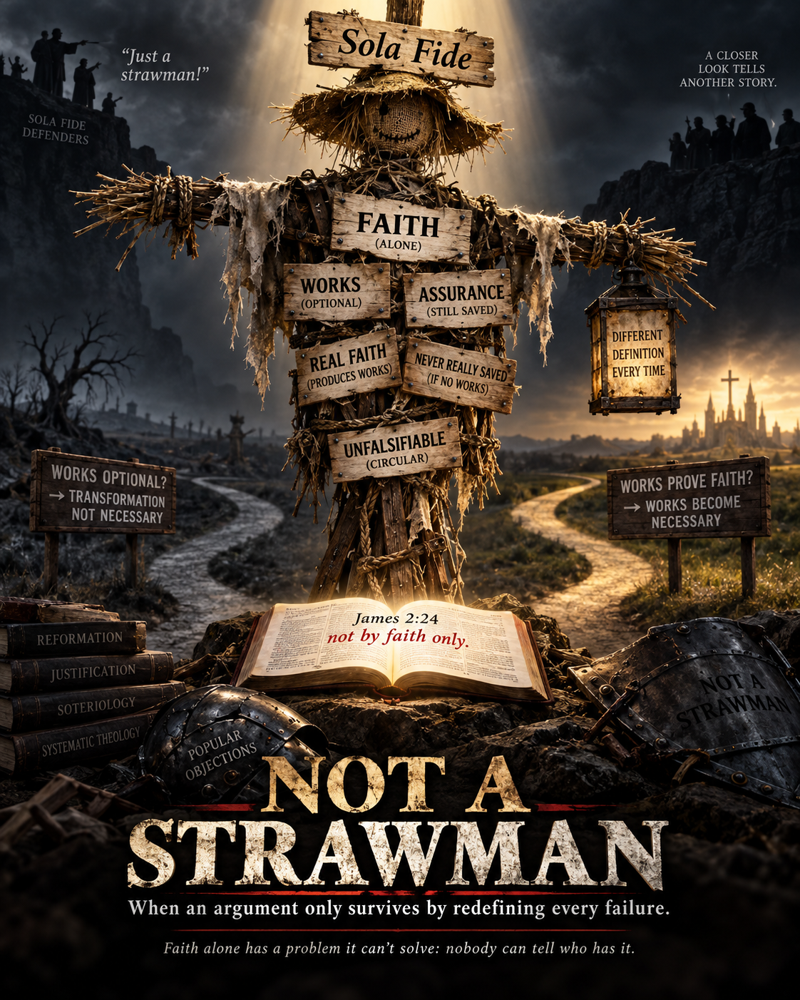
Sola Fide — The Happy Thought Problem
Latter-day Saints are often told that “believe, then live however you want” is an unfair description of faith alone. This page explains why the description is accurate, using the words of the people who teach the doctrine, and then shows what the scriptures teach instead.
What the Doctrine Says
Most Protestant churches teach that a person is justified — declared righteous before God — by grace through faith in Christ, apart from works. The phrase matters. Justification, on this view, is an event that happens at the moment of belief, before any obedience exists. What does the believer have at that moment? A belief and a moment, and by the doctrine’s own account nothing more, because nothing more has yet been asked of him.
Teachers of the doctrine usually add that true faith “does not remain alone” and that good works will follow. Notice what kind of statement that is. It is a prediction about the future, not a condition of the justification that already happened; if the works never come, the justification stands anyway, for it was finished before they were due. That is why the description “a happy thought, then live however you want” is not a caricature but the doctrine with the clock run forward.
Is that too hard a reading? The people who hold the doctrine do not think so, and several of them say it in print.
The Doctrine in Its Own Words
The Grace Evangelical Society, founded in 1986 and still publishing, states its purpose on its homepage: God gives everlasting life through faith in Christ “apart from works done before or after the new birth” (faithalone.org). After the new birth as well as before it — works are not required at ANY point.
That position came out of Dallas Theological Seminary. Zane Hodges (Absolutely Free!, 1989) and Charles Ryrie (So Great Salvation, 1989) defended it against John MacArthur’s The Gospel According to Jesus (1988) in what Evangelicals still call the Lordship Salvation controversy. MacArthur described Hodges’s teaching this way: “you can be an unbelieving believer, he said; you can deny Christ and still go to heaven” (Ligonier). The controversy was an argument inside Protestantism, and both sides held to faith alone; the Christian Research Institute’s summary says “Neither side is saying that salvation is by works” (Lyle, CRI). They disagreed only on whether faith alone permits a life without obedience, and one side answered yes.
Nor is the idea new; it is older than Dallas. Martin Luther wrote to Philip Melanchthon on August 1, 1521: “Be a sinner and sin boldly, but believe and rejoice in Christ even more boldly.” A few lines later in the same letter: “No sin will separate us from the Lamb, even though we commit fornication and murder a thousand times a day” (Luther’s Works 48:281–282). His defenders read that as hyperbole about grace, and perhaps it was, but the point of the hyperbole is exactly the point at issue: no amount of sin touches the standing of the one who believes.
Then add eternal security. The Baptist Faith and Message 2000, Article V, teaches that those God has accepted in Christ “will never fall away from the state of grace,” and that believers who “fall into sin through neglect and temptation” shall still be “kept by the power of God through faith unto salvation” (bfm.sbc.net).
Put the two together — justified apart from works, and unable to be lost — and the doctrine logically permits any life at all after the moment of faith. Most believers do not live that way, and that is to their credit. But the doctrine allows it, and the Grace Evangelical Society says so on purpose.
The Question the Doctrine Cannot Answer
How does a person know he is saved? The usual answer is that works are the evidence of real faith. But then, until the works appear, no one can tell a saved person from a person who merely had a happy thought, because at the moment of justification the two are IDENTICAL — one belief, one moment, no works. Yet the doctrine also teaches assurance of salvation right now, on the strength of the faith moment alone. Both cannot be true. Either assurance comes from faith alone, and works are optional, or assurance waits on the works, and works are a condition of salvation.
John answered the question long before the Reformation asked it:
“And hereby we do know that we know him, if we keep his commandments. He that saith, I know him, and keepeth not his commandments, is a liar, and the truth is not in him.”
And when the works never do appear? The doctrine has one reply: he was never really saved. Consider what that does. If every missing fruit is explained as missing faith, then “true faith always produces works” stops being a claim about the world and becomes a definition that no evidence can touch. Can anyone tell whether a man’s faith was genuine? No one can, and the doctrine is arranged so that no one ever has to. A teaching that survives only by declaring its failures invisible has not passed the test of Matthew 7:16; it has declined to take it.
What the Data Shows
The claim that saving faith “produces” obedience can be measured. David Ayers, an Evangelical sociologist at Grove City College, analyzed the federal National Survey of Family Growth and the General Social Survey for the Institute for Family Studies in 2019 (“Sex and the Single Evangelical”). Roughly two-thirds of Evangelical young people had engaged in sexual intercourse. Among never-married Evangelical adults, 86% of women and 82% of men had at least one partner since age 18. Only 37% of “fundamentalist” adults said sex outside marriage is always wrong.
At the level of profession, in other words, Evangelical behavior tracks the general population. The gap opens only where there is ongoing practice — weekly attenders aged 18–22 drop to 51% — so the thing that actually changes behavior is the thing the doctrine calls unnecessary for salvation. The faith did not produce the obedience; the practice did.
What Paul Actually Set Aside
The proof texts for faith alone are Romans 3:28, Romans 4:5, and Ephesians 2:8–9. What are the “works of the law” in those verses? The ceremonial law of Moses — circumcision above all — and Paul says so: “Circumcision is nothing, and uncircumcision is nothing, but the keeping of the commandments of God” (1 Corinthians 7:19). The ritual is set aside. The commandments are not.
The same Paul on conditions
- Romans 2:13 — “the doers of the law shall be justified.”
- Philippians 2:12 — “work out your own salvation with fear and trembling.”
- 1 Corinthians 9:27 — “lest that by any means, when I have preached to others, I myself should be a castaway.”
- Galatians 5:19–21 — those who do the works of the flesh “shall not inherit the kingdom of God.”
Paul feared becoming a castaway himself, and he warned the Galatians that certain conduct forfeits the kingdom. A man who believed conditions had been abolished would not write either sentence. Paul abolished circumcision, and NOTHING else.
Where the Word “Alone” Came From
The doctrine is named for a word that is not in the Bible. No Greek manuscript of Romans 3:28 contains “alone.” Luther added it to his 1522 German translation, and when he was challenged he admitted it in his 1530 Open Letter on Translating: “the word ‘solum’ is not present in either Greek or Latin text — the papists did not have to teach me that — it is fact! The letters s-o-l-a are not there.” His answer to anyone who objected: “Dr. Martin Luther will have it so… I will it, I command it; my will is reason enough” (read the letter). He went on to argue that German idiom required the word, and it may have — but idiom does not put a word into the Greek.
The phrase “faith only” does appear in scripture, exactly once, and the word in front of it is NOT.
James, Read as Written
“Ye see then how that by works a man is justified, and not by faith only.”
The common reply is that James is only condemning “dead, empty profession” and is not discussing salvation. Read him. His opening question is “can faith save him?” (2:14) — salvation, not demonstration. He says “by works was faith made perfect” (2:22), and that the reckoning of Genesis 15 was “fulfilled” at Moriah decades later (2:23). Works complete faith. That is the order James wrote, and it is the order the restored gospel teaches.
Jesus taught the same order Himself. “If thou wilt enter into life, keep the commandments” (Matthew 19:17). “Not every one that saith unto me, Lord, Lord, shall enter into the kingdom of heaven; but he that doeth the will of my Father” (Matthew 7:21). “If ye keep my commandments, ye shall abide in my love” (John 15:10). Christ “became the author of eternal salvation unto all them that obey him” (Hebrews 5:9).
What the Restored Gospel Teaches
Faith is the first principle of the gospel, not the whole of it. “We believe that the first principles and ordinances of the Gospel are: first, Faith in the Lord Jesus Christ; second, Repentance; third, Baptism by immersion for the remission of sins; fourth, Laying on of hands for the gift of the Holy Ghost” (Articles of Faith 1:4). That is Peter’s order on the day of Pentecost — believe, repent, be baptized, receive the Holy Ghost (Acts 2:37–38) — and it is why the Book of Mormon can say both that “it is by grace that we are saved, after all we can do” (2 Nephi 25:23) and that a disciple must “press forward with a steadfastness in Christ… and endure to the end” (2 Nephi 31:19–20). Grace saves; it does not save a person who refuses to walk.
Does that make salvation a wage earned by works? No, for no one earns the Atonement, and the Book of Mormon is emphatic that we are “unprofitable servants” however much we do (Mosiah 2:21). The difference is covenant. A covenant has terms on both sides, and the saving faith of scripture is the faith that keeps its side of them — which is why Moroni ends the book by telling the reader to “deny yourselves of all ungodliness” and only then promises that “his grace is sufficient for you” (Moroni 10:32).
Paul read whole, James read as written, Christ’s own words, the Reformers in their own letters, and the federal data all agree. The faith that saves is the faith that keeps covenant. A happy thought is where discipleship begins, and a happy thought is all it is until a person gets up and follows.