The Pre-Existence in Latter-day Saint Doctrine
Where do we come from?
One of the great questions that have been asked throughout history is where do I come from?
We might ask ourselves why do we ask this? Consider that our consciousness exists now — has it always existed? If it has then asking this makes perfect sense.
If it was created and is only connected to the physical body it does not. Also you will note that if our consciousness is only connected to our physical body then we must also accept that sexual reproduction produces consciousness. It would also mean that at physical death and the decay of a mortal body an individual is effectively Destroyed. They would then be re-created at the time of the resurrection. Then we must realize that Jesus Christ died, and was dead for 3 days—was God thus dead? Did God no longer exist? These types of paradoxical questions do not apply if our consciousness is independent of the body.
What is an Intelligence?
We affirm that our consciousness is an emergent property of an entity known as an intelligence. What then are the characteristics of an intelligence? Modern revelation can provide a lot of information on this topic. The concept of pre-existence, or premortality, is a fundamental teaching in The Church of Jesus Christ of Latter-day Saints (LDS Church). It encompasses the belief that all human beings existed as spirit children of God before their mortal birth on Earth. This doctrine provides a framework for understanding the purpose of life, the nature of humanity, and the eternal plan of salvation.
It is a being of light/energy only—it has no material form and is eternal in nature. Doctrine and Covenants 93:29–31
It is an eternal entity it has always existed, will exist, and can in fact NEVER be destroyed Abraham 3:21
It has the following capacities It can make choices — accept knowledge or reject that knowledge It can remember — it can grow in knowledge and thus must remember what it learned at least to some degree It is sentient — it has a consciousness and has self awareness — for without agency there is no existence D&C 93:30 It can be embodied — it can enter into and control a body
Progression is Embodiment — Spirit Bodies
Intelligences have the capacity to grow and improve, but their potential is limited without embodiment. Embodiment is essential for achieving a fullness of joy and increased capability (D&C 93:33–34). The Plan of Salvation, or God’s work and glory, is centered around empowering intelligences through the process of embodiment, which allows them to progress.
Therefore in order for intelligences to progress God organized spirit bodies for these intelligences using a unique form of matter called spirit matter, which has form, extension in space, and features like physical bodies, including hands, eyes, and gender (Doctrine and Covenants 131:7, Ether 3:16–17). By giving these intelligences new spirit bodies, God is considered the Father of all humanity, as described in Romans 8:16–17. For the process of creating a new body and embodying a being within it is the definition of being a parent.
The method and means by which these spirit bodies are organized/created has not been revealed and we have absolutely no revelation concerning it. If there are any claims that are made concerning this topic it is mere assumption and inference. We just don’t know how they are created.
We also know that when an intelligence is organized and placed in spirit bodies they are equal, they start at the same state, they were then allowed to choose and because of their choices they gained greater light and knowledge and were given additional capabilities/opportunities (Alma 13:3–5, Abraham 3:19–22, D&C 93:36–39, D&C 50:24, D&C 93:29–32, D&C 138:50). Thus individuals developed traits, personalities, and capabilities that were unique among the children of God. He then selected them BASED upon these choices, to receive different experiences in this life in order for their perfection and improvement, their empowerment and their development. It wasn’t just God’s whim—it was based upon law and thus receipt based upon that obedience to law. (D&C 130:19–21)
In the premortal life, spirits progressed at different rates based on their choices and obedience to divine principles. Jesus Christ excelled in intelligence and righteousness, becoming “like unto God” (Abraham 3:19). This progression set the stage for our mortal journey, where we continue to exercise agency and strive for eternal growth.
Gaining New Capacities
When an entity embodies a new body, they gain control over new forms of energy and capabilities, and abilities beyond what they previously possessed. Spirit bodies provide them with spatial extension and the capacity to experience spirit matter. This embodiment allows intelligences to learn, understand, and experience more. The senses and capabilities gained through embodiment offer an expanded ability to interact with reality.
Intelligence Within the Body and Energy Under Control
Bodies contain embedded intelligence, such as systems that operate independently of conscious control. For example, the immune system, the sympathetic nervous system, and reflexes are aspects of the body that exhibit organized, dynamic intelligence. The DNA, cellular structures, and systems work together harmoniously, reflecting an intricate design that adds to the embodied intelligence of beings. Thus when embodiment occurs the intelligence gains control of a massive amount of new energy, and intelligence that it never had before. It has Progressed. (D&C 93:33–34)
God’s Embodiment and Progression
God himself is an intelligence who has been embodied as a spirit and later as an immortal, resurrected physical being. Humans, as God’s children, share his essence and possess divine attributes and potential for growth. As God stands at the pinnacle of progression, he continues to work and advance by empowering others, fulfilling his purpose and glory through their development. (D&C 130:22, Moses 1:39)
The Grand Council and the Plan of Salvation
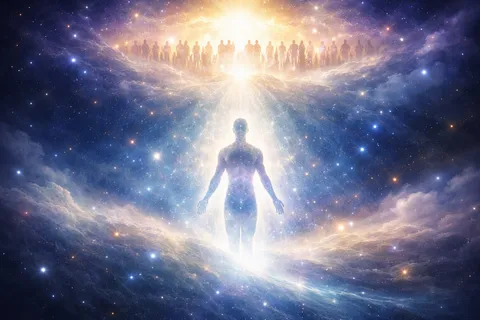
In the premortal existence, Heavenly Father convened a Grand Council to present the Plan of Salvation — a blueprint for our eternal progression and happiness (Abraham 3:22–23). Central to his plan was the necessity of gaining a physical body, experiencing mortality, and exercising agency to choose between good and evil. This plan was proposed by God and a discussion of the plan took place among the children of men concerning it.
Part of this plan was the FACT that each and every one of us would fail in our attempts to live according to the light and knowledge that we would receive during the course of our temporal existence on earth. We would be surely damned, and our eternal progression would STOP and we would lose our bodies that he had given unto us. For that is the law and the consequences for disobedience and the consequence physical death, and separation from God. For God cannot destroy the agency of man and its capacity i.e. the capability to choose is central to the plan that was presented. For without this choice — individuals could not progress, but would rather be damned.
Yet he also proposed in this plan that there would be “Good News” that the consequences of this eternal law could be overcome for all mankind and that through the efforts of ONE individual all mankind might be redeemed from Death, and all mankind may be redeemed from their choices and mistakes. Yet this one individual must come to earth and live an absolutely PERFECT life not breaking a single commandment and being SINLESS before God or all would be lost. This individual would be known as the redeemer, the mediator of the atonement between man and God.
Jesus Christ and Lucifer
Jesus Christ, the Firstborn of the Father, volunteered to be the Savior, accepting the role of Redeemer to enable the plan’s fulfillment (Moses 4:2; Abraham 3:27). Conversely, Lucifer, another of God’s spirit children, rebelled against the plan. He sought to destroy human agency by proposing an alternative that would force righteousness and deny individuals the freedom to choose (Moses 4:1, 3). This would be by using the knowledge and power of God to set up the situation such that EVERYONE would ALWAYS make the right choice and thus ALL mankind would be redeemed and saved to Celestial Glory. Yet was this progression? Were the individuals choosing? Could such an alteration to the plan succeed? This rebellion led to a “war in heaven,” a conflict of ideas and agency rather than physical combat. Yet we knew that Lucifer was lying for he was a liar and an accuser of his brethren—and we knew that his alteration of the plan actually destroyed its results. Thus many of us rejected him, and his councils, and strongly encouraged our brothers and sisters to do so as well.
Thus we exercised GREAT faith in Jesus Christ and accepted him as our redeemer believing that he would do as he had volunteered to do. For God knew that he would be successful in his mission and that we could, and should put our trust in God as well as our brother Jehovah — who became Jesus the Christ.
The War in Heaven and the Fall of Lucifer
Lucifer and those who followed him were cast out of heaven, denied the opportunity to receive physical bodies and progress further (Abraham 3:28). This event underscores the eternal significance of agency; even God does not override it. Agency is an inherent characteristic of our intelligence and cannot be removed (Doctrine and Covenants 93:30–31). He was cast out by Jehovah and others because of their love of God, and their testimony of Jesus Christ. (Rev 12:7–9, Abr 3:27–28, D&C 29:36–37, D&C 76:25–27, Moses 4:3–4)
Biblical Evidence of Pre-Existence
While some believe the Bible lacks references to pre-existence, several passages suggest otherwise:
Hebrews 12:9: Refers to God as the “Father of spirits,” distinguishing Him from mortal fathers of flesh and implying a paternal relationship that precedes mortal embodiment.
Jeremiah 1:5: God states that He knew, sanctified, and ordained Jeremiah before his physical formation, indicating personal identity and purpose prior to mortal birth.
Ecclesiastes 12:7: Describes the spirit returning to God at death, implying that the spirit existed with God before entering the body.
John 9:1–3: The disciples’ question assumes the possibility of sin prior to birth; Jesus corrects their conclusion, not the premise, leaving pre-mortal existence unchallenged.
Acts 17:28–29: Paul calls humanity the “offspring of God” (Greek genos), indicating shared lineage or family relationship rather than a purely metaphorical creation.
Isaiah 14:12–20 — Uses the king of Babylon as a type for Lucifer, describing a conscious being who fell from a prior exalted position; later identified as a “man,” reinforcing personal identity rather than abstract evil.
Job 38:4–7 — Describes the “sons of God” rejoicing at the creation of the earth, placing conscious beings in existence before the world was formed.
1 Kings 22:19 — Portrays the Lord presiding over a heavenly council, showing an organized assembly of beings participating in divine governance.
Daniel 7:9–10 — Depicts a divine court with innumerable beings standing before God, reinforcing the concept of a populated heavenly realm prior to mortal history.
Rev 12:7–11 — Describes a war in heaven involving Satan and other beings, indicating moral agency and conflict before earthly life.
Isaiah 49:1 — Speaks of being called by the Lord before birth, suggesting identity and divine purpose preceding mortal life.
Psalm 139:13–16 — Emphasizes God’s knowledge of the individual prior to physical formation, supporting continuity of identity beyond mere biological development.
Romans 8:29 — Refers to foreknowledge and predestination to become like Christ, implying prior distinction and relationship before mortal experience.
Numbers 16:22 — Identifies God as the “God of the spirits of all flesh,” distinguishing spirits from bodies and implying their existence apart from mortality.
Malachi 2:10 — Asks whether all do not have “one Father,” reinforcing a shared divine parentage rather than a merely symbolic relationship.
John 1:1–14 — Teaches that Christ existed with God in the beginning and later became flesh, establishing clear pre-mortal existence.
John 6:38 — Christ states that He came down from heaven, affirming conscious existence prior to mortal birth.
John 8:58 — Jesus declares existence before Abraham, asserting eternal identity beyond mortal chronology.
John 17:5 — Christ speaks of glory shared with the Father before the world existed, confirming premortal consciousness.
Philippians 2:5–7 — Describes Christ existing in the form of God before humbling Himself to take on mortality.
Colossians 1:15–17 — Declares Christ to be before all things and the agent of creation, affirming His existence prior to the material universe.
The Importance of a Physical Body
Obtaining a physical body is essential in LDS theology. It allows spirits to progress, experience mortality, learn, grow, and eventually attain a fullness of joy (Doctrine and Covenants 93:33–34). The body and spirit together constitute the soul, and the resurrection reunites them eternally. This is the second estate of man, in other words the second body that they will receive in their empowerment process as they move through the plan of salvation. It is called an estate because it is a house, an abode, a place that their spirits enter and control and abide within. This estate is temporary—there will come a time when everyone will die. Their spirits will leave their bodies and they will await in hell or paradise their upcoming Resurrection. Their resurrection is an EVENT that happens once to an individual. They are reunited with their physical body but it is changed, it is incorruptible, it is immortal and it is glorious by what ever degree of glory that they will receive. They will never die again—worlds without end.
Satan’s Limitations
Those who followed Lucifer forfeited the opportunity to receive physical bodies. As a result, Satan and his followers lack the power and experiences that come with mortality. While they can tempt and influence, they cannot force individuals to sin or override their agency. They are considered weak after our resurrection, and will be as an abominable branch that does not join their brothers in burial and resurrection. No — they are damned for all eternity to remain mere spirits never to progress and never receive a mortal glorious body worlds without end.
Premortal Choices and Accountability
Questions arise about whether spirits could sin before mortal life and how such actions were addressed. Scriptures like Alma 13:3–5 suggest that priesthood leaders were “called and prepared from the foundation of the world,” implying premortal righteousness. However, the full extent of accountability and repentance in the premortal life remains a subject of faith and study. We know that all mankind is Innocent as they are born in to this world, and thus if they had been under the consequence of sin — that had been redeemed, perhaps in a preparatory redemption for such. But this and or any other theory is mere assumption until and unless we receive greater light and knowledge via revelation.
Conclusion
The doctrine of pre-existence clarifies human identity and purpose within Latter-day Saint theology. It teaches that we are literal spirit children of God whose existence did not begin at birth and does not end at death. Mortal life is a continuation of premortal progression, providing the necessary conditions for agency, growth, accountability, and embodiment.
This doctrine preserves the coherence of justice and mercy, explains the necessity of a Savior, and affirms the eternal value of the body. God’s work and glory are the embodiment and empowerment of intelligences, carried out in harmony with eternal law. Because agency is fundamental, outcomes are shaped by choice and consequence rather than compulsion. Through Jesus Christ, progression continues beyond mortality for all who are willing to receive it.