
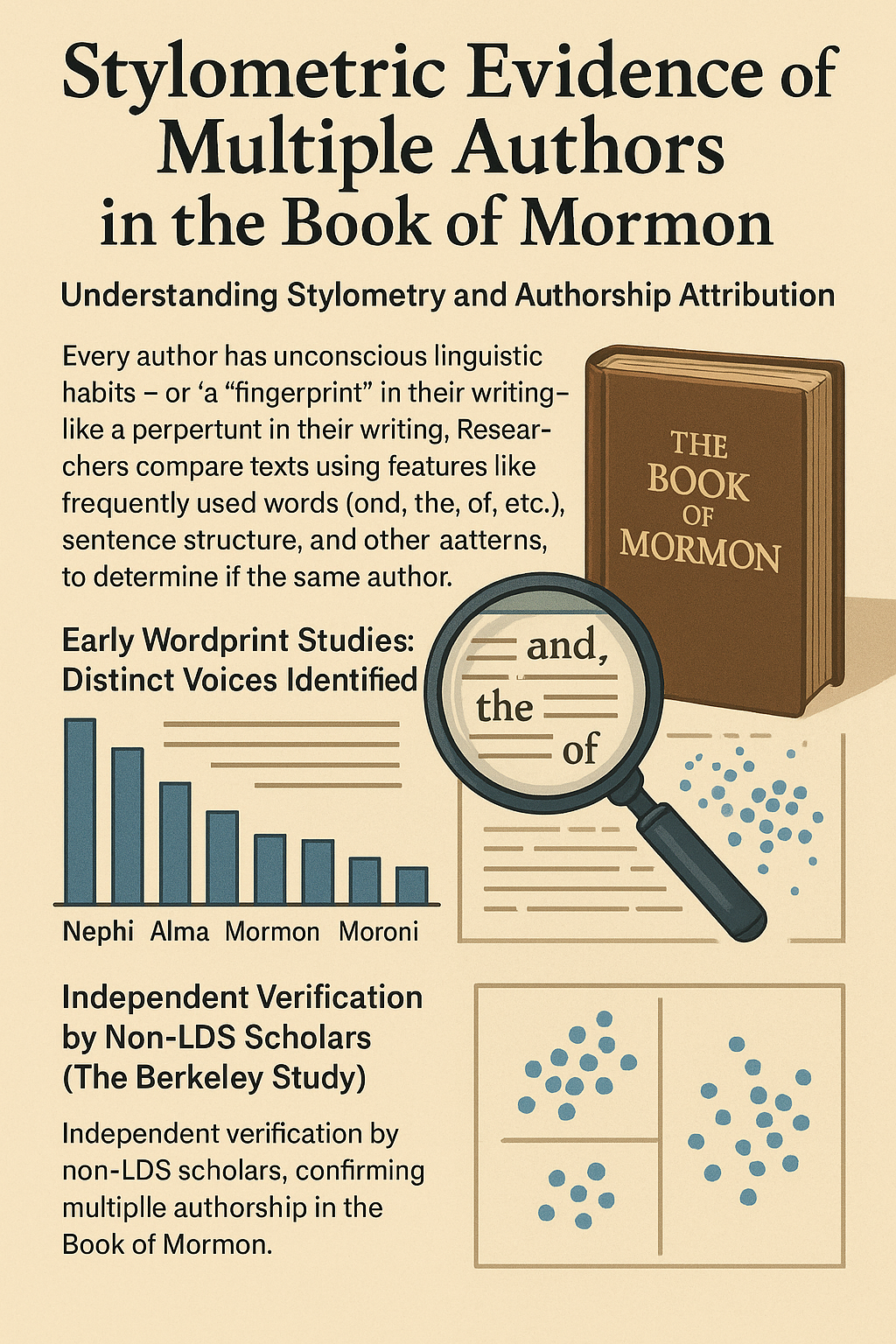
Stylometric Evidence of Multiple Authors in the Book of Mormon
Statistical analysis of writing style confirms distinct authorial voices in the Book of Mormon, consistent with the book’s own internal claims.
Understanding Stylometry and Authorship Attribution
Stylometry (also called wordprint analysis) is the statistical study of writing style. The basic premise is that every author has unconscious linguistic habits—like a “fingerprint” in their writing—that remain consistent across their works. By quantitatively examining features such as frequently used words (especially common, non-contextual words like and, the, of, etc.), sentence structure, and other patterns, researchers can compare texts to determine if they likely share the same author. This technique has successfully resolved disputed authorship in famous cases (e.g. the Federalist Papers and certain Shakespeare works). Notably, studies have shown that an author’s distinctive style can persist even through translation—an important consideration since the Book of Mormon is said to be a translation. In short, stylometry provides an objective, data-driven way to test whether the Book of Mormon was written by one person or by multiple distinct authors as it claims.
Early Wordprint Studies: Distinct Voices Identified
The first major stylometric analysis of the Book of Mormon was carried out by LDS scholars Wayne A. Larsen, Alvin C. Rencher, and Tim Layton in 1980. They compared writings attributed to 24 different narrators in the Book of Mormon and also compared these to writings by potential 19th-century authors such as Joseph Smith, Oliver Cowdery, Sidney Rigdon, and Solomon Spaulding. Using three separate statistical tests of word frequencies, Larsen and colleagues found clear evidence of multiple distinct writing styles within the Book of Mormon. In their words, the Book of Mormon was written in “distinct authorship styles,” and none of the tested 19th-century writer samples “resemble Book of Mormon authors in style.” The researchers concluded that the book “was written by many authors,” and that no part of it was written by any commonly suggested 19th-century author.
Although some critics scrutinized this pioneering study, subsequent research revealed flaws in critical responses. When more robust methods were applied, the initial findings of Larsen and Rencher held strong. The earliest wordprint analyses laid the groundwork by indicating the Book of Mormon contains multiple, distinguishable writing styles while disproving the hypothesis of a single 19th-century author.
Independent Verification by Non-LDS Scholars (The Berkeley Study)
A major milestone came in 1990, when John L. Hilton led a team of mostly non-LDS researchers at UC Berkeley in a more sophisticated authorship study. This “Berkeley Group” sought to rigorously test the 1980 results with improved techniques and larger controls. They analyzed word-patterns (combinations and ratios of common words) across the text and compiled an extensive control dataset: writings from 26 different texts by 9 known authors (totalling 325 pairwise comparisons).
Before ever testing the Book of Mormon, the Berkeley study demonstrated two important things: (1) an author’s stylistic “fingerprint” remains detectable even if they attempt to write in a different voice or persona, and (2) translation does not erase an author’s unique patterns.
When they applied their refined methods to the Book of Mormon itself, Hilton and his colleagues decisively confirmed multiple authorship. They concluded it is “statistically indefensible” to claim that Joseph, Oliver, or Spaulding wrote the 30,000-word sample attributed to Nephi and Alma. Furthermore, the analysis showed that Nephi’s and Alma’s writings each have unique wordprints “in the same fashion that other uncontested authors do.” The Berkeley team concluded the evidence indicates the Book of Mormon was “indeed multi-authored, with authorship consistent with its own internal claims.”
The Berkeley study’s results have also been independently replicated. In 2006, a team of researchers at Utah State University applied a generalized discriminant analysis to the Book of Mormon and essentially reproduced Hilton’s findings.
Modern Analyses and Refinements (2000s)
In 2008 a team of non-LDS researchers at Stanford (Matthew Jockers, Daniela Witten, and Craig Criddle) published a peer-reviewed study applying two advanced methods to Book of Mormon authorship. They also found evidence of multiple distinct authorial “voices” in the text, but their analysis reported that the Book of Mormon’s literary style most closely matched writings of Solomon Spaulding and Sidney Rigdon.
Subsequent reviewers identified significant methodological flaws in Jockers’ approach. The most critical issue was treating the authorship question as a “closed-set” problem—assuming the true author must be among the candidate set provided. This closed-set assumption guaranteed that some 19th-century candidate would appear as the “closest match,” even if the real author was none of the above. In sum, while the 2008 study affirmed multiple authors, its attribution to specific 19th-century writers is now regarded as an artifact of a flawed experimental design.
In 2011, Paul Fields, G. Bruce Schaalje, Matthew Roper, and their team introduced an Extended NSC (Nearest Shrunken Centroid) classification method explicitly designed for an “open-set” authorship problem—allowing for the possibility that the true author might not be among the pre-selected candidates. The results were illuminating: after fixing the earlier study’s errors, Sidney Rigdon and Solomon Spaulding each had a 0% probability of being the author of the Book of Mormon, and Joseph Smith’s probability was near zero (about 3%). By contrast, the stylometric classifier found a 93% probability that the Book of Mormon was written by one or more author(s) NOT in the candidate set. Their paper concluded that the most likely explanation is that the Book of Mormon’s author(s) are not any modern person(s) known to history—a conclusion that directly contradicts all theories of purely 19th-century origin.
Converging Evidence and Implications
Looking at all these studies together, a clear picture emerges. By all robust measures, the Book of Mormon reads as if it were written by many different authors, just as it claims. Stylometric research has been repeated and refined by different teams, using different techniques, and they consistently find the same thing: distinct authorial signatures within the text and no plausible single modern author behind it. Studies that disagreed with those claims (like the Holmes study or the Jockers study) “were later found to be fundamentally flawed,” whereas the Larsen, Hilton, and Fields studies each produced sound results and reinforce one another.
The strongest stylometric evidence supports the conclusion that (1) the Book of Mormon was written in multiple, distinct authorship styles, (2) those styles align with the book’s own internal divisions by author, and (3) none of the proposed 19th-century candidates have a style matching the Book of Mormon. These findings directly undermine the theory that Joseph Smith simply invented the Book of Mormon in the 1820s.
It must be emphasized that stylometry, by itself, cannot prove the Book of Mormon’s ancient authenticity—it cannot tell us who the authors were, only that there were many and who they were not. However, it adds significant weight to the book’s claim of ancient origin by eliminating the most popular naturalistic explanations. The data strongly refute one-author or conspiracy theories, and they align neatly with the traditional understanding that prophets like Nephi, Mormon, and Moroni each contributed their own voices to the record.
In practical terms, this means a reader can approach the Book of Mormon text and legitimately treat the voices of Nephi, Alma, Mormon, etc., as distinct personalities. Such evidence, coming from rigorous scholarly inquiry, bridges the gap between faith and empirical analysis. It shows that faith in the Book of Mormon’s multi-author origin is not at odds with cutting-edge research; on the contrary, the research to date corroborates that aspect of the narrative in a striking way.