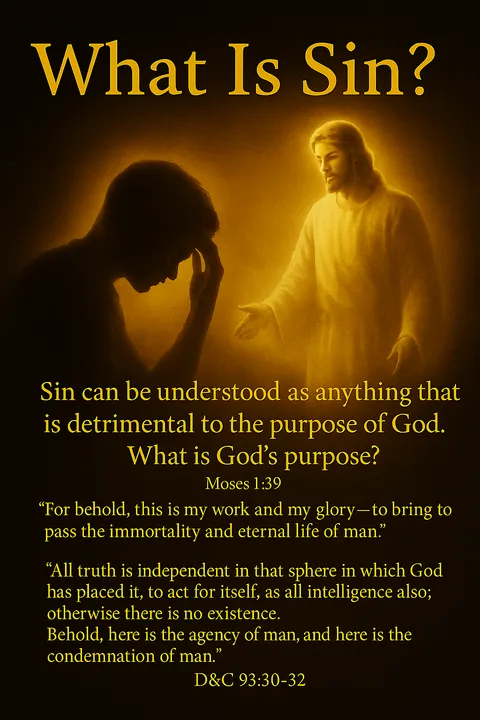
What Is Sin?
Sin can be understood as anything that is detrimental to the purpose of God.
What is God's purpose? As stated in Moses 1:39: “For behold, this is my work and my glory—to bring to pass the immortality and eternal life of man.”
This purpose underscores the eternal progression and salvation of God’s children. The Doctrine and Covenants provides additional insight into how this purpose relates to our agency and accountability:
“All truth is independent in that sphere in which God has placed it, to act for itself, as all intelligence also; otherwise there is no existence. Behold, here is the agency of man, and here is the condemnation of man; because that which was from the beginning is plainly manifest unto them, and they receive not the light. And every man whose spirit receiveth not the light is under condemnation.”
From these scriptures, we learn that our agency allows us to act upon the truth we receive. Condemnation arises when we choose to reject light and truth—essentially acting in opposition to God’s purpose.
Sin Defined
Sin is the willful disobedience of God’s commandments or the failure to act righteously despite knowing the truth. The Lord has declared: “I, the Lord, cannot look upon sin with the least degree of allowance” (D&C 1:31).
When we sin, we experience the withdrawal of the Holy Ghost, and our actions make us unable to dwell in the presence of our Heavenly Father, for: “No unclean thing can dwell with God” (1 Nephi 10:21). For no being who has rejected light and truth is capable of doing so—God is full of light and truth and all those who dwell with him are also.
Sin and Its Effects
The effects of sin are profound and multidimensional, impacting both the spiritual and physical state of an individual. By rejecting light and truth, individuals sever their connection to God, whose light sustains all creation (D&C 88:13). This disconnection introduces spiritual decay, manifesting as guilt, sorrow, and a loss of divine guidance through the Holy Ghost (D&C 93:39). Without this connection to divine light, the spirit and body become vulnerable to darkness, weakening their ability to resist further sin and temptation. This withdrawal stunts spiritual growth and limits the body’s capacity to fully experience joy and peace, which are gifts of righteousness (2 Nephi 2:25; 2 Nephi 9:39).
This spiritual separation also alters the body, which is designed as a sacred vessel to house God’s Spirit (1 Corinthians 3:16–17). Sin disrupts the harmony of the body and spirit, leading to both physical and emotional turmoil. Chronic guilt, stress, and negative patterns of behavior—often associated with sin—can manifest in fatigue, illness, and mental distress. The body, intended to be an instrument of light and truth, becomes compromised by the consequences of sin. Thus, although not all illness and physical disabilities and trauma are connected to sin, the results of sin can lead to such infirmities and trials (John 9:1–3; Mosiah 23:21–22).
Sin also hinders the influence of the Holy Ghost. When individuals persist in rebellion against God, the Holy Ghost withdraws. This absence leaves them spiritually bound, with diminished capacity to discern, understand, and accept truth (D&C 1:31; 1 Timothy 4:2; 2 Nephi 2:27). This resistance to truth and accountability leads to spiritual stagnation and further estrangement from God’s light (2 Nephi 9:28–29; 2 Nephi 28:21–22; Moses 4:3–4).
Loss of Knowledge / Loss of Light and Truth
As individuals distance themselves from the Church of Jesus Christ of Latter-day Saints, and thus the gospel of Jesus Christ, a spiritual phenomenon often occurs: they begin to lose the clarity, understanding, and testimony they once possessed. This is not merely a matter of memory, but of the spiritual withdrawal of light and truth. As Alma teaches, “…they that will harden their hearts… know nothing concerning his mysteries; and then they are taken captive by the devil…” (Alma 12:11). This principle is reiterated in Doctrine and Covenants 93:39: “That wicked one cometh and taketh away light and truth, through disobedience, and because of the tradition of their fathers.”
In this condition, people may forget key doctrinal insights, lose spiritual discernment, and even deny truths they once affirmed. One should be cautious in giving weight to critiques of the gospel made by those who have long since ceased to walk in its light (see Alma 24:28–30; 1 Corinthians 2:14; Hebrews 6:4–6).
This, paradoxically, may reflect a degree of divine mercy. As knowledge increases accountability (Jacob 2:9–10; D&C 82:3), the loss of remembered spiritual truth can mitigate future condemnation (compare Mosiah 26:3). However, the tragedy remains: without repentance and restoration through Christ, this is what is meant by the chains of hell.
“And therefore, he that will harden his heart, the same receiveth the lesser portion of the word; and he that will not harden his heart, to him is given the greater portion of the word, until it is given unto him to know the mysteries of God until he know them in full. And they that will harden their hearts, to them is given the lesser portion of the word until they know nothing concerning his mysteries; and then they are taken captive by the devil, and led by his will down to destruction. Now this is what is meant by the chains of hell.”
Conclusion
Whenever we do anything that hinders the immortality and eternal life of ourselves, our families, or others, we are acting in opposition to God’s purpose. This is the essence of sin. For the results of sin are death—separation from our bodies, and separation from God. Thus it is once again any action, thought, or omission that works against the fulfillment of God’s plan to bring His children back to His presence. Understanding sin in this way emphasizes the importance of aligning our choices with God’s commandments and purpose.