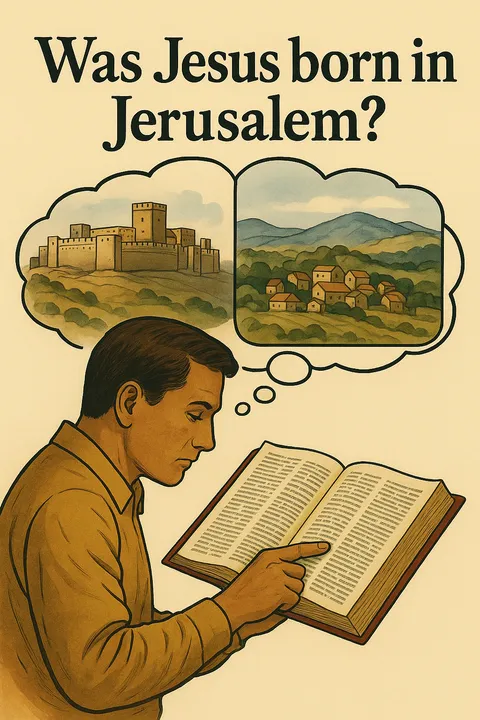
Was Jesus Born in Jerusalem?
The Book of Mormon says the Messiah would be born “at Jerusalem”—and this is entirely consistent with how ancient Israelites used that term.
Introduction
Ancient writers often used “Jerusalem” in both a narrow and a broad sense. In the narrow sense it named the fortified hill-city itself; in the broad sense it embraced “the land of Jerusalem”—all the towns, villages, and pasturelands under its political and cultic orbit in the kingdom of Judah. The Old Testament shows this dual usage repeatedly. David “took the stronghold of Zion, that is, the City of David” (2 Sam 5:6–9), yet the narrator can still say he “dwelt at Jerusalem” (2 Sam 11:1–2) and later “returned to Jerusalem” with his army (2 Sam 12:31). Jeremiah distinguishes “Jerusalem and the cities of Judah” yet also speaks of the Babylonian enemy coming “against all its walls all around and against all the cities of Judah” (Jer 1:15), treating them as a single theater of judgment.
Within that larger land of Jerusalem sat Bethlehem, five to six miles to the south-southwest. Luke explicitly calls Bethlehem “the City of David” (Luke 2:4, 11)—the same title 2 Samuel applies to Zion in Jerusalem proper. In other words, biblical usage is fluid: “City of David” can point to Zion/Jerusalem in one text and to Bethlehem in another, because both places share Davidic significance inside the same regional matrix.
When the Book of Mormon’s early writers (e.g., 1 Nephi 1:4; Alma 7:10) say the Messiah would be born “at Jerusalem, which is the land of our forefathers,” they follow this ancient convention. They are not locating Jesus inside the walled city; they are situating His birth within the broader land ruled from Jerusalem, exactly where Bethlehem lies. Far from betraying ignorance, the expression matches the scriptural habit of letting “Jerusalem” stand metonymically for its dependent towns—especially at major pilgrimage seasons when the population of those “waste cities” swelled with worshippers attending the feasts (Ezek 36:37–38).
Biblical Examples Showing Jerusalem Refers to Its Surrounding Land
2 Samuel: The City of David Is AT Jerusalem
“David took the stronghold of Zion, that is, THE CITY OF DAVID… And David lived IN THE STRONGHOLD AND CALLED IT THE CITY OF DAVID.”
How can David “dwell at Jerusalem” (2 Sam 11:1) while arising “from his couch” in a house that is outside the original city walls? Because “AT JERUSALEM” includes the Land of Jerusalem, which includes the cities and areas outside of Jerusalem itself.
The New Testament Confirms It
“And Joseph also went up from Galilee, from the town of Nazareth, to Judea, TO THE CITY OF DAVID, WHICH IS CALLED BETHLEHEM, because he was of the house and lineage of David.”
So, the Old Testament says that the City of David is AT JERUSALEM, and the New Testament says that the City of David is called Bethlehem. The Book of Mormon is not inconsistent by saying that the Messiah would be born AT JERUSALEM.
Jeremiah and Ezekiel Confirm the Broad Usage
“…they shall come…against all its walls all around AND AGAINST ALL THE CITIES OF JUDAH.”
“…LIKE A FLOCK AT JERUSALEM DURING HER APPOINTED FEASTS, SO SHALL THE WASTE CITIES BE FILLED WITH FLOCKS OF PEOPLE.”
Bethlehem was one of these WASTE CITIES in the LAND OF JERUSALEM, THE KINGDOM OF JUDAH. This explains why there was no room at the inn in Bethlehem: because “flocks” were gathered AT JERUSALEM for the Feast of Passover, FILLING THE WASTE CITIES—to include “the House of Bread,” or Bethlehem, THE CITY OF DAVID, which is AT JERUSALEM.
Common Objections and Their Answers
Objection: “Micah 5:2 explicitly names Bethlehem; therefore any authentic prophet should do the same.”
Micah’s prophecy singles out Bethlehem because it wishes to highlight the Messiah’s humble Davidic roots, not to create an exclusive postal address. Yet ancient writers regularly shifted scale. A Nephite prophet describing the event from six centuries’ remove can naturally speak of the birth occurring “in the land of our forefathers, at Jerusalem,” because Bethlehem lies squarely inside that land. Far from contradicting Micah, the phrasing simply uses a wider geographic lens.
Objection: “Joseph Smith accidentally wrote ‘Jerusalem’ instead of ‘Bethlehem.’”
If it were merely a slip, later editorial revisions (the 1837 and 1840 editions, which silently corrected dozens of printer’s mistakes) would almost certainly have replaced it with “Bethlehem”—yet they did not. Early LDS apostles defended the wording when challenged as early as the 1840s, showing that the phrase was noticed, discussed, and deliberately retained.
Objection: “Alma’s audience would have known to say Bethlehem, not Jerusalem.”
Alma’s audience—descendants of people who had lived in that milieu—would instinctively recognize the elastic scope of the phrase. Near the opening of 1 Nephi, Lehi “dwelt at Jerusalem” yet travels outside the city gates to preach and to gather his family—behavior that only makes sense if “at Jerusalem” can describe the metro area, not merely an address inside the walls.
Summary
Each criticism rests on either a modern expectation of one-to-one wording or on unfamiliarity with ancient Near-Eastern linguistic habits. Once those habits are acknowledged—cities standing for their districts, prophetic paraphrase rather than quotation, and bilingual flexibility—the statement that Jesus would be born “at Jerusalem” fits comfortably within biblical and extrabiblical precedent.
In short, the Book of Mormon’s wording is entirely consistent with the semantic range the Bible itself assigns to “Jerusalem.” The charge of contradiction evaporates once we read the texts the way ancient Israelites did—recognizing a geographic term that flexes between city, temple-center, and surrounding district.