
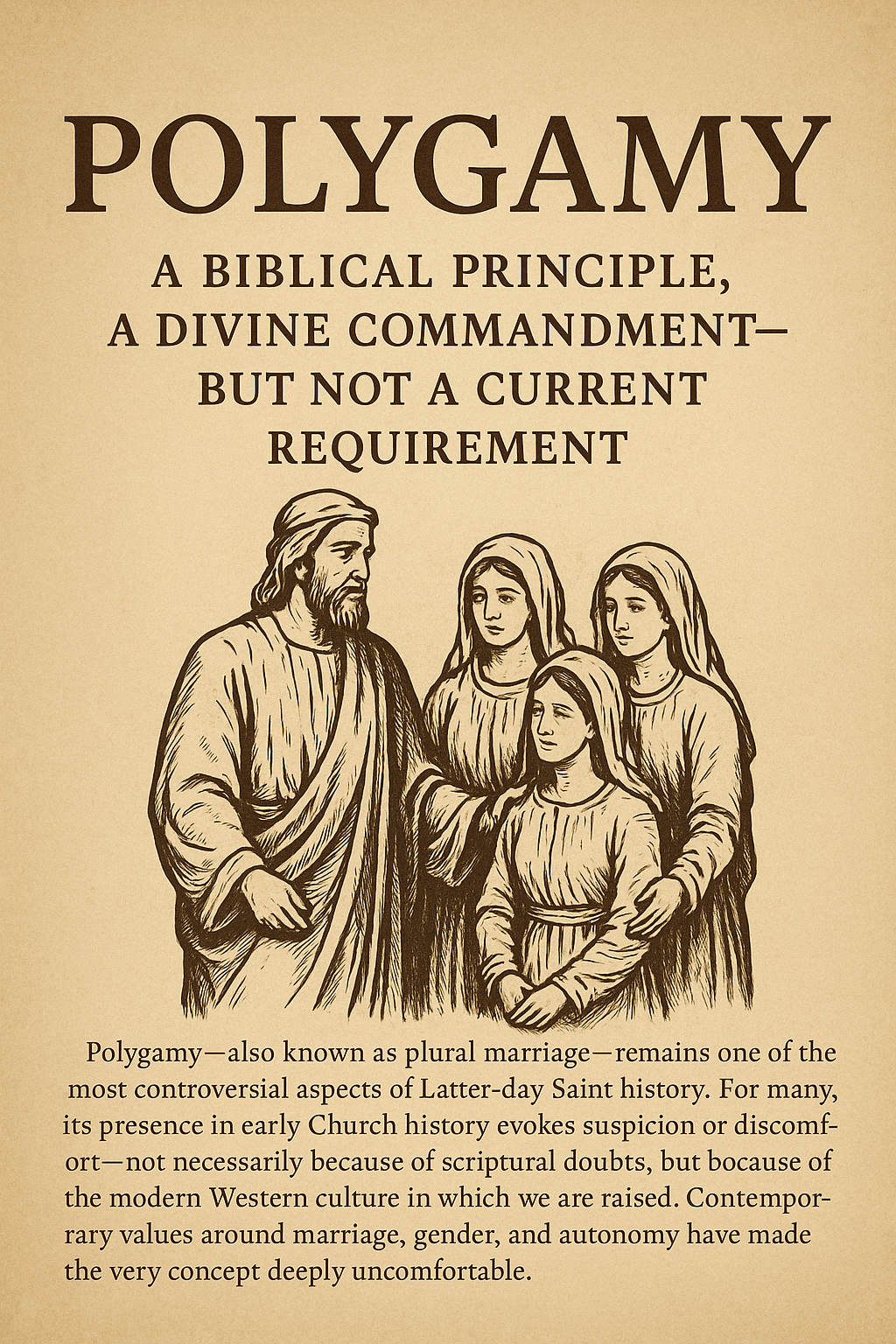
Polygamy: A Biblical Principle, a Divine Commandment—But Not a Current Requirement
Understanding plural marriage in the context of scripture, covenant theology, and world history.
Polygamy—also known as plural marriage—remains one of the most controversial aspects of Latter-day Saint history. For many, its presence in early Church history evokes suspicion or discomfort—not necessarily because of scriptural doubts, but because of the modern Western culture in which we are raised. Contemporary values around marriage, gender, and autonomy have made the very concept deeply uncomfortable. But those who dig deeply into scripture, covenant theology, and world history recognize that plural marriage is both historically and theologically consistent—an eternal principle that God has revealed at specific times for specific covenant purposes. Though not practiced today, plural marriage remains a true part of the restored gospel—governed entirely by revelation and priesthood authority, never by private whim.
1. Plural Marriage: Commanded, Not Merely Permitted
Some claim that the Bible merely “allows” polygamy as an unfortunate cultural relic, never as a divine command. This is demonstrably false. The Law of Moses required polygamy in certain cases—Levirate marriage (Deuteronomy 25:5–10) commanded a man to marry his brother’s widow, whether or not he was already married. Refusal was shamed, showing this was not optional. Later Jewish tradition limited the practice for pragmatic reasons—not because God had changed the law.
Likewise, 2 Samuel 12:7–8 records God Himself giving David multiple wives and declaring He would have given even more. The sin for which David was rebuked was adultery and murder—not polygamy. If God truly abhorred the practice, why would He bestow it as a divine blessing?
Other Torah regulations (Exodus 21:10; Leviticus 18:18) assume plural marriage and regulate it, not abolish it. The point is clear: polygamy, when commanded or regulated by God, is not sinful.
2. Monogamy: A Cultural Norm—Not a Universal Divine Law
Many Christians argue that monogamy is the only true biblical model, citing Genesis 2:24 and Jesus’s affirmation in Matthew 19. But these texts speak to the origin and sanctity of marriage, not to a universal limit on spouses. The phrase “one flesh” describes intimacy, not arithmetic; by the same logic, remarriage after widowhood would be banned—yet the New Testament permits it (Romans 7:2–3).
Jesus’s teaching in Matthew 19 addresses divorce, not polygamy. Nowhere does Christ explicitly ban plural marriage, even as He interacts positively with the descendants of the patriarchs—most of whom were polygamists.
The historical and anthropological record is clear: over 80% of pre-industrial societies permitted polygamy (pmc.ncbi.nlm.nih.gov), including God’s covenant people. Monogamy became the legal norm in the West only due to Greco-Roman and later Christian tradition—not because of a biblical prohibition.
3. God Sanctioned and Structured Polygamy Through His Prophets
Far from merely tolerating polygamy, God actively sanctioned and even commanded it among His prophets: Abraham, Jacob, Moses, David, and others. The very foundation of Israel—the twelve tribes—comes from a polygamous household (Jacob with four wives). Abraham’s relationship with Hagar and Sarah was not condemned; God blessed both lines. Moses had more than one wife, and God defended him against criticism (Numbers 12:1–10; D&C 132:38).
The problem in Solomon’s case was not polygamy per se, but idolatry and disobedience in marrying outside the covenant (1 Kings 11:1–10; Deut. 17:17). Nowhere in scripture does God rebuke Abraham, Jacob, or Moses for polygamy; instead, He blesses and covenants with their families.
The Doctrine and Covenants explicitly confirms that these prophets were justified when acting under God’s command—and condemned only when acting without it (D&C 132:38–39).
4. LDS Doctrine: Plural Marriage as an Eternal Principle—Not Always Required
Critics allege that LDS plural marriage is an unbiblical “addition.” Yet continuing revelation is a core biblical principle (John 16:12–13; Amos 3:7; Acts 3:21). Jesus taught that not all truth had yet been revealed. Latter-day Saints accept additional scripture and continuing revelation, in full continuity with biblical precedent.
Matthew 22:30—that there is no “marrying or giving in marriage” in the resurrection—refers to new marriages after death, not to the cessation of eternal marriage covenants made in mortality (see also Matthew 16:19). The sealing power to bind families for eternity is foundational LDS doctrine.
The Book of Mormon affirms monogamy as the rule, except when God commands otherwise for covenant purposes (Jacob 2:27–30). Plural marriage is therefore not a universal commandment, but an eternal principle invoked only by explicit divine revelation. (LDS doctrine on Plural Marriage)
5. Only God Can Authorize Plural Marriage—Authority and Obedience Matter
Scripture is clear: priesthood authority matters (Hebrews 5:4; Matthew 16:19; Acts 1:24–26). Christ gave keys to His apostles, who set binding rules for the Church—including on marriage. Polygamy, when authorized, was always regulated by priesthood authority. In the Restoration, Joseph Smith introduced the practice only by direct command, and it was carefully overseen by the prophet and apostles. When God withdrew the command in 1890 (Official Declaration 1), faithful Saints obeyed. Plural marriage has never been a free-for-all.
Obedience to current commandment is always the standard for salvation—not the number of spouses. Those who practice polygamy today are excommunicated, just as those who refused the principle when commanded in the 19th century were out of harmony with God’s will.
6. Polygamy Across Religious Traditions—A Broader Perspective
Judaism, Christianity, Islam, and numerous cultures have recognized plural marriage as morally acceptable or even expected. Islamic law still permits it (Qur’an 4:3); Judaism practiced it for centuries; even Christian reformers like Martin Luther acknowledged its biblical legitimacy.
The universality of polygamy in world history—especially among the righteous—undercuts any claim that it is self-evidently evil or a mark of apostasy. Monogamy as the exclusive standard is a product of specific cultural evolution, not a universal divine law.
Conclusion: A Law Revealed by God, Governed by Him Alone
Cultural norms shift; doctrinal truth does not. God’s commandments sometimes run counter to worldly values and test the faith of His people. The Saints who lived plural marriage did so at great cost, and ceased by commandment at great cost as well. Both were acts of sanctifying obedience—Abrahamic tests for their generation.
Plural marriage is not a stain to hide or a footnote to regret. It is a scripturally grounded, covenantal principle that God has employed at pivotal moments in salvation history—neither superior to monogamy nor required for exaltation, unless and until God commands it.
Latter-day Saints affirm that:
- Plural marriage was divinely practiced by ancient and modern prophets, never condemned by God when commanded.
- It is a revealed law, not a man-made invention or cultural accident.
- It is not currently commanded; monogamy is obedience for our time.
- It remains an eternal principle—practiced only under priesthood authority and God’s express will.
In a world swayed by shifting trends, we are governed by revelation. We neither flinch from this doctrine nor attempt to impose it. We seek to understand, contextualize, and obey God’s will in every season He appoints.
Polygamy in Scripture, History, and Law—For Further Study
Scriptural Foundations
Torah / Old Testament
- Genesis 16:1–4 — Abraham, Sarah, and Hagar.
- Genesis 29–30 — Jacob’s household with Leah, Rachel, Bilhah, and Zilpah.
- Exodus 21:10 — Regulation of multiple wives’ rights.
- Deuteronomy 21:15–17 — Inheritance law requiring equal treatment of sons from multiple wives.
- Deuteronomy 25:5–10 — Levirate marriage (commanded plural marriage).
- 2 Samuel 12:7–8 — God gives David multiple wives.
- 1 Kings 11:1–10 — Solomon condemned for idolatry, not polygamy.
- Malachi 3:6 — “I am the Lord, I change not.”
New Testament
- Matthew 19:3–9 — Christ on divorce, not polygamy.
- Matthew 22:23–30 — Teaching on resurrection marriages, not eternal sealings.
- 1 Corinthians 7:2, 7:39 — Guidance on marriage and widowhood.
- 1 Timothy 3:2 — “Husband of one wife” (office regulation, not universal command).
Book of Mormon
- Jacob 2:27–30 — Monogamy is the rule; God may command plural marriage for covenant purposes.
Doctrine and Covenants / Pearl of Great Price
- D&C 132:38–39 — Prophets justified in polygamy when commanded by God.
- Official Declaration 1 — God rescinds commandment in 1890.
- Articles of Faith 1:12 — Saints obey civil law except where it contradicts God’s law.
Historical Perspectives
Ancient World
- Rome — First codification of monogamy by Romulus (Sabine women story).
- Jewish Tradition — Polygamy permitted until medieval times; Rabbi Gershom (960–1028) restricted it for cultural reasons.
- Josephus — Jewish historian who practiced polygamy (wives in Palestine and Egypt).
Protestant Reformers & Modern Era
- Martin Luther & Philip of Hesse (1539) — Luther sanctioned a plural marriage.
- King Henry VIII — Practiced secret plural marriage while founding the Church of England.
- Jewish practice — Continued in Spain and the East into the 14th century.
Latter-day Saint History
- Joseph Smith (1843) — Revelation on plural marriage (D&C 132).
- 1852 — Public announcement of the practice.
- 1862 Morrill Anti-Bigamy Act — Beginnings of U.S. legal persecution.
- 1882 Edmunds Act — Stripped voting rights, jury service, and office from believers in polygamy.
- 1887 Edmunds-Tucker Act — Confiscation of LDS property, disenfranchisement of children of plural marriage.
- 1890 Manifesto — Official Declaration 1 ends commanded practice.
- 1972 RLDS (now Community of Christ) — Allowed polygamists into membership, reversing their earlier opposition.
Recommended Secondary Sources
- Polygamy in the Bible, Ogden Kraut (esp. Ch. 24: “Contest at Law”).
- History and Philosophy of Marriage, Campbell.
- History of the Variations of the Protestant Churches, James Benign Bosuet.
- Jewish Encyclopedia, Vol. 10, pp. 120–121.
- Keightley, History of the Roman Empire, Part 2, Chap. 7.
- LDS Gospel Topics Essay: Plural Marriage in the Church.
- Catholic.com: The Protestants’ Problem with Polyamory.