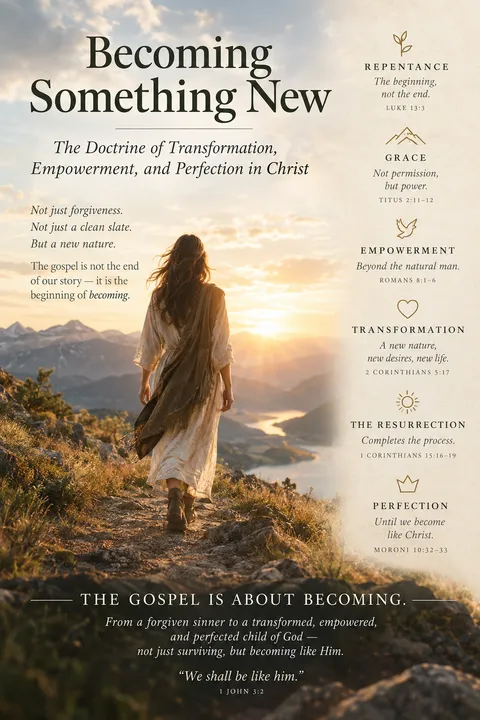
Becoming Something New
The Doctrine of Transformation, Empowerment, and Perfection in Christ
Many speak of the gospel of Jesus Christ as though its purpose is simply forgiveness—as though its end is to pardon sin, relieve guilt, and allow man to return to God unchanged. That is not what scripture teaches. Forgiveness is not the goal; it is the beginning (see Acts 2:38; Alma 11:37). Repentance is not a moment. It is not a checklist. And it is not a transaction where you pay for what you’ve done wrong. It is the process by which a person is changed—not by their own power, but through the grace of Jesus Christ (see 2 Corinthians 7:10; Alma 34:31–33). The gospel is not designed merely to cleanse man, but to transform him—to alter his nature, empower his capacity, and ultimately perfect his being until he becomes like Christ Himself (see Romans 12:2; 2 Corinthians 3:18; Moroni 10:32–33). Anything less is not the gospel described in scripture.
Repentance Is the Beginning of Becoming
Repentance is essential; without it there is no salvation (see Luke 13:3; Mosiah 3:12). But repentance is not the end of God’s work—it is the entry point into it. Every time you repent, you are not just correcting behavior; you are becoming something different. Your desires begin to shift, and what once pulled you begins to lose its hold. This is not self-discipline alone—it is transformation (see Galatians 5:16–17; Mosiah 5:2). King Benjamin’s people described it as a mighty change—a new disposition (see Mosiah 5:2–5). This is not behavioral restraint but a change in nature. The natural man is not merely controlled; he is replaced (see Mosiah 3:19; Ephesians 4:22–24).
The Gospel Changes What You Want
This is where many misunderstand the gospel. They assume righteousness is a constant battle of resisting desire. But scripture teaches something deeper: God changes the desires themselves. Those who are born of God do not continue in sin as before (see 1 John 3:9; Alma 36:24); they walk in newness of life (see Romans 6:4). They retain a remission of sins, grow in humility, are filled with the love of God, and do good continually—not because they must, but because they want to (see Mosiah 4:11–12). “If any man be in Christ, he is a new creature” (see 2 Corinthians 5:17). Conversion is not compliance; it is becoming.
Grace Is Power, Not Permission
This transformation does not originate in man; it is enabled entirely through Jesus Christ. “Come unto Christ… then is his grace sufficient… that by his grace ye may be perfect in Christ” (see Moroni 10:32). Grace is not merely forgiveness—it is power (see Titus 2:11–12; Ether 12:27): power to change, to overcome, to become. We are strengthened with might by His Spirit (see Ephesians 3:16), and God works in us both to will and to do (see Philippians 2:13). Grace does not simply excuse weakness; it transforms it.
Empowerment: Beyond the Natural Man
The natural man is weak—aware of what is right yet unable to consistently do it (see Romans 7:18–24; Mosiah 3:19). But through Christ, that condition is not managed; it is overcome. Those who walk after the Spirit are no longer bound as before (see Romans 8:1–6; Galatians 5:24–25). As individuals yield to God, they are made free from sin (see Romans 6:18–22). Weakness becomes strength (Ether 12:27), and change becomes sustainable as we abide in Christ (see John 15:4–5).
You Become What You Choose
This transformation is governed by eternal law. “That which ye do send out shall return unto you again” (see Alma 41:3–5; Galatians 6:7–8). You are not simply judged; you are restored to what you have become. Your nature determines your destiny (see Romans 8:6).
Without the Resurrection, This Process Fails
This transformation is not complete without the resurrection. If the flesh does not rise, the entire plan collapses (see 2 Nephi 9:8–9; 1 Corinthians 15:16–19). A fullness of joy requires body and spirit inseparably connected (see D&C 93:33–34; Luke 24:39).
Conclusion: The Gospel Is About Becoming
The gospel of Jesus Christ is not merely about avoiding punishment or being forgiven. It is about becoming something fundamentally different. Through Christ, the sinner becomes clean (see Isaiah 1:18), the weak become strong (Ether 12:27), the natural man becomes spiritual (Mosiah 3:19), and the fallen become divine (see 2 Peter 1:4). Repentance begins it, grace empowers it, resurrection completes it, and perfection fulfills it. The final outcome is not survival—it is transformation. “We shall be like him.”