Did Christ Fail?
If the Church fell into apostasy, does that make the Savior a failure? The answer turns on a question most people never think to ask: what happens to everyone who died without ever hearing His name.
Anyone who talks about the Restoration for long will meet this objection, usually phrased with some heat. Christ promised that the gates of hell would not prevail against His Church. Latter-day Saints teach that the Church He organized fell away and had to be restored. Put those two statements together and the conclusion looks obvious: either the promise failed or the Restoration is unnecessary.
Fair question. It deserves a real answer rather than a slogan, and it deserves better than a shrug. But the answer is not where most people look for it. The matter is not finally about Matthew 16 at all, and it is not settled by counting centuries of church history.
It turns on what a person believes happens to the dead.
The Problem Every Theology Has to Solve
Demographers at the Population Reference Bureau estimate that about 117 billion human beings have been born on this earth. Most of them lived and died without ever hearing the name of Jesus Christ spoken once. They were born before Bethlehem, or on continents no missionary reached for another fifteen hundred years, or in villages where the gospel simply never arrived. Add the infants. Add the children who died young, and those who never had the mental capacity to understand a sermon.
So what does God do with them? The question is not a curiosity at the edge of theology. It is the test every doctrine of salvation has to pass. Peter stated the standard plainly on the day the gospel first went to the Gentiles.
“Of a truth I perceive that God is no respecter of persons: but in every nation he that feareth him, and worketh righteousness, is accepted with him.”
A God who is no respecter of persons cannot sort His children by the accident of where they were born. Yet without some provision for the dead, that is exactly what happens, and the sorting is done by latitude and by century. The Christian traditions that emerged from the Reformation felt the weight of this and answered it directly in their confessions, so it is worth reading what they concluded.
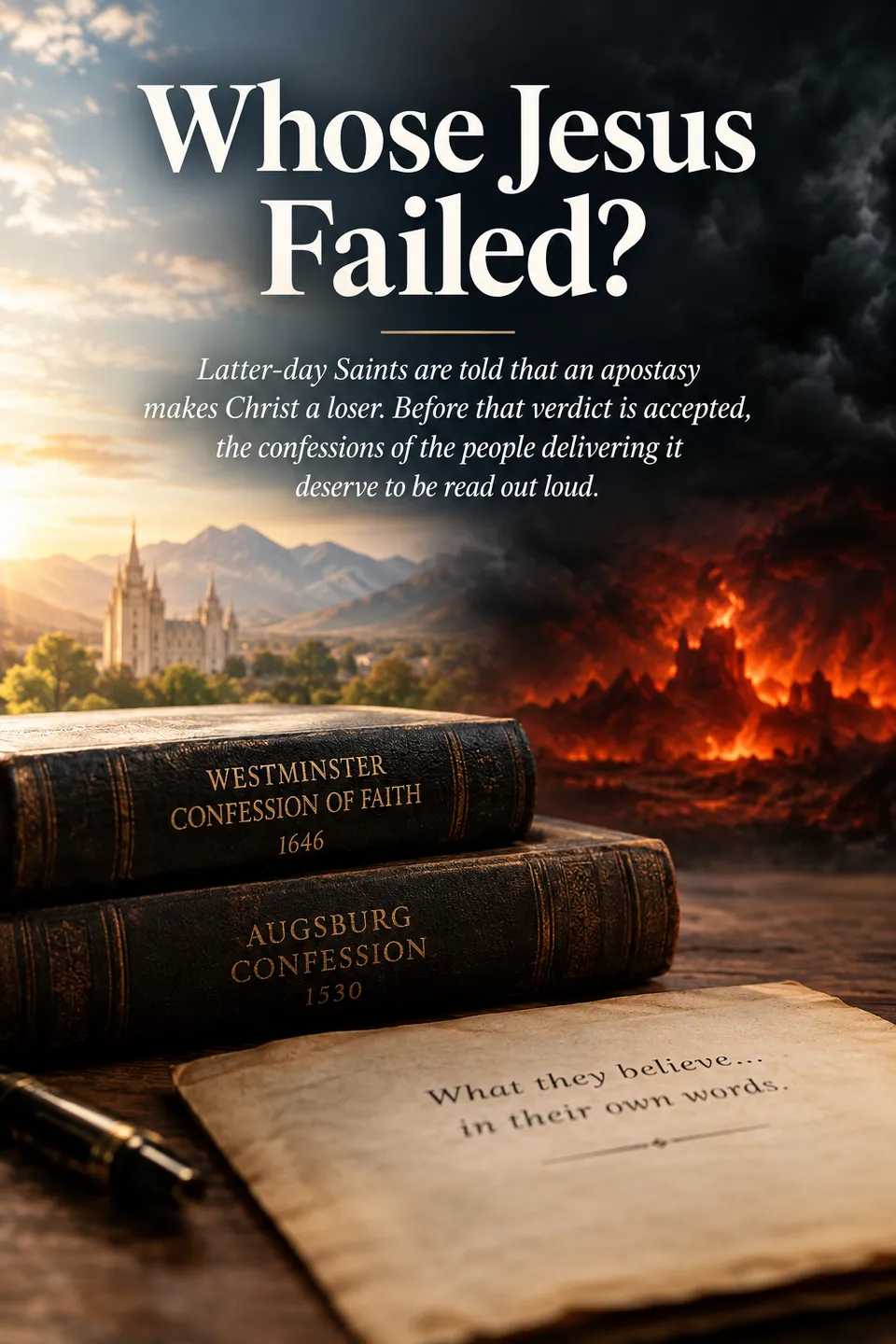
Westminster Confession of Faith, 10.4
“Much less can men, not professing the Christian religion, be saved in any other way whatsoever, be they never so diligent to frame their lives according to the light of nature, and the laws of that religion they do profess. And, to assert and maintain that they may, is very pernicious, and to be detested.”
The same confession describes only two destinations for the departed, and closes the subject: “Besides these two places for souls separated from their bodies, the Scripture acknowledgeth none” (32.1). The Augsburg Confession of the Lutherans reaches the same endpoint from another direction, teaching that the ungodly will be condemned “to be tormented without end,” and condemning those who believe the punishment will ever stop (Article XVII).
Those are honest documents written by serious men. Nobody is caricaturing them here, and nobody needs to; they wrote the words themselves and their churches confess them still. But look at what produced those sentences. A theology with no doctrine of the dead has nowhere to put the billions. So the problem gets closed by decree rather than answered, and the hope of an answer is condemned along with it.
Peter Says Christ Went to Them
The New Testament does not leave the dead unaccounted for. It tells us where the Savior spent the interval between the cross and the empty tomb, and what He did there.
“Being put to death in the flesh, but quickened by the Spirit: by which also he went and preached unto the spirits in prison; which sometime were disobedient, when once the longsuffering of God waited in the days of Noah.”
Notice who is in that prison. Not the righteous waiting for their reward. The disobedient — the generation of the flood, the very people a doctrine of no second hearing places beyond every remedy there is. And the Lord went to them. Why would He go, if nothing could be done for them once they were there?
The Book of Mormon fills in the geography of that world. Alma explains that the spirits of the righteous are received into a state of rest and peace, while the wicked wait in darkness for the day of their resurrection, both groups conscious, both groups awake, and both groups still themselves (Alma 40:11–14). Nobody there is asleep. Nobody there has stopped being a person who can hear a message and answer it.
Peter answers the question in his next chapter, and he supplies the purpose in the same sentence.
“For for this cause was the gospel preached also to them that are dead, that they might be judged according to men in the flesh, but live according to God in the spirit.”
The gospel is preached to the dead so that they may LIVE. Read the purpose clause again if it went by too quickly, because Peter put the reason right in the sentence. Christ Himself had already taught the same thing during His mortal ministry: “The hour is coming, and now is, when the dead shall hear the voice of the Son of God: and they that hear shall live” (John 5:25).
In October 1918, President Joseph F. Smith was shown what the Savior actually organized in that world. He saw that Christ did not preach in person to the wicked and disobedient, but organized His forces and appointed messengers to carry the gospel to them, so that the work would go forward continuously and not end with His resurrection (Doctrine and Covenants 138:29–34). Missionary work did not begin in the spirit world on that Friday afternoon and stop on Sunday morning. It is still going on right now.
Hearing Is Not Enough, So Ordinances Are Supplied
Preaching alone would only solve half the problem. Christ told Nicodemus that a man must be born of water and of the Spirit to enter the kingdom of God, and a disembodied spirit has no body with which to be baptized. So how can the dead who accept the gospel receive the ordinance that the gospel requires?
Someone with a body does it for them. Paul mentions the practice in passing, in the middle of his great defense of the resurrection, and he treats it as something the Corinthian Saints were already doing and already understood.
“Else what shall they do which are baptized for the dead, if the dead rise not at all? why are they then baptized for the dead?”
Paul does not condemn the practice, correct it, or distance himself from it. He uses it as evidence for the resurrection, which only works as an argument if his readers accepted the practice as legitimate. A man does not prove a true doctrine by appealing to a false one.
The most common concern raised about this teaching deserves a direct answer, because it comes up every time. Does baptism for the dead force salvation on people who never chose it? Not in the slightest. The ordinance is offered, not applied. It waits, exactly as a proxy baptism performed for a living person would wait if he refused it, and the man or woman in the spirit world remains free to accept the covenant or to decline it. Agency is not suspended by death. The dead still CHOOSE.
The second concern is just as common. Is this not works-righteousness, salvation earned by ritual rather than received by grace? Consider what is actually being described. One person does for another what that person is entirely powerless to do for himself, and the whole benefit arrives as a gift. Nothing in that opposes the Atonement of Jesus Christ. It is a small copy of it, and it teaches the pattern better than a sermon can.
Hell Delivers Up Its Dead
There is one more piece, and it changes the shape of the entire question. In the scriptures, hell is not the final state of anyone except the sons of perdition. Hell is a place people come out of.
“And the sea gave up the dead which were in it; and death and hell delivered up the dead which were in them… And death and hell were cast into the lake of fire.”
Read the order of events in that verse. Hell surrenders the people it held. Then hell itself is DESTROYED. Jacob taught the same sequence six hundred years before John saw it, and his language is even more explicit: death and hell must deliver up their dead, and hell “must deliver up its captive spirits, and the grave must deliver up its captive bodies” (2 Nephi 9:12).
Even those who reject the gospel entirely and suffer for their own sins are not abandoned there forever. The vision of the glories says they are cast down to hell only “until the fulness of times, when Christ shall have subdued all enemies under his feet” (Doctrine and Covenants 76:106). Afterward they receive a kingdom, and the revelation describes even that lowest kingdom as a glory which “surpasses all understanding” (76:89).
Only one group ends outside all of it, and the description is narrow and specific. They received the fulness of light, knew the Father and the Son perfectly, and then denied and defied that knowledge with their eyes open (Doctrine and Covenants 76:31–38). What seals that outcome is not a decree made before they were born. It is a fully informed choice made by people who could not possibly have misunderstood what they were choosing.
Now Ask the Question Again
With all of that in place, return to the objection. If authority was lost and ordinances were corrupted for centuries, what was actually lost with them?
Time. Light. Clarity for generations who deserved better. Those are real losses and nobody should minimize them. But not one soul is permanently forfeited, because the gospel continues to be preached to the dead and every ordinance can still be performed on their behalf. Consider a woman who died in Wales in 1340. She is not lost to Christ for having been born in the wrong century. Her name can be found. Her work can be done in a temple. The choice then belongs to her, as it always should have.
So the doctrine of the Restoration answers the objection instead of collapsing under it. An apostasy in a world where the dead can still hear and still receive is a delay in the work. An apostasy in a world where death seals every door would be a catastrophe beyond measuring, and the God who allowed it could not be called merciful in any sense the word normally carries.
So the charge of a failed Christ lands somewhere its authors never intended. The question was never whether an institution could fall. It was always whether the Atonement reaches everyone it was offered to, and that is answered by what the Savior did with three days and what He organized to continue afterward.
What This Asks of You
This doctrine is not an argument to win. It is an assignment. And it has your name on it.
The last verses of the Old Testament promise that Elijah will come to turn the hearts of the fathers to the children and the hearts of the children to their fathers, lest the whole earth be smitten with a curse (Malachi 4:5–6). Joseph Smith understood the reason for that urgency and stated it in one line: “For we without them cannot be made perfect; neither can they without us be made perfect” (Doctrine and Covenants 128:18).
Everything argued above is worthless if it stops at the level of theory. Somewhere behind you is a line of people who never had what you have, and there is a temple where their work can be done. Finding one name is a more complete answer to the charge than any page of reasoning, because it is the doctrine being practiced rather than defended.
Christ did not lose the billions who never heard His name. He went to them Himself, He sent messengers who are still working, and He arranged a way for the living to finish what the dead could not. Whatever else the centuries did to the Church He founded, that work never stopped for a single day.
Sources quoted above:
Westminster Confession of Faith (1646) — chapters 10 and 32, full text at opc.org.
Augsburg Confession (1530), Article XVII — bookofconcord.org.
Population Reference Bureau, “How Many People Have Ever Lived on Earth?” — prb.org, 2022 estimate of about 117 billion births.
Related pages:
The Great Apostasy — what was lost, and why a Restoration was required.
Gates of Hell — what the promise in Matthew 16 actually says.
Salvation for the Dead — the doctrine laid out in full.
Baptism for the Dead — the ordinance, its history, and its scriptural basis.
The Spirit World — where the dead are, and what they are doing.
Family History & Temple Work — how to start, and why it matters.