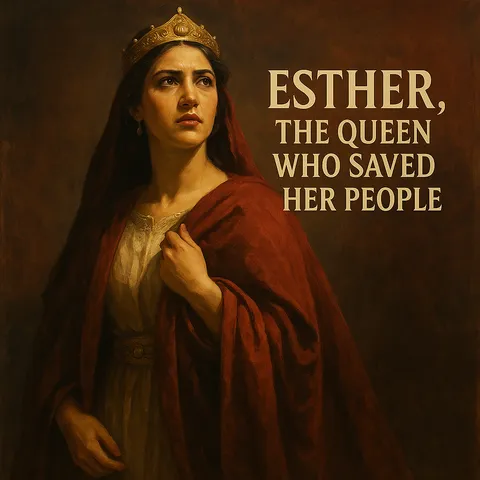
Esther, the Queen Who Saved Her People: A Profile in Courage, Divine Timing, and Deliverance Inside a Broken System
Esther is often remembered for beauty and bravery, but this softens the truth. Her greatness emerges not from spiritual ease but from inside an imperial system that was coercive, patriarchal, and morally fractured. Esther did not choose this life; she was taken into the Persian court (Esther 2:8), placed in a polygamous royal structure (Esther 2:14), and married to a pagan king outside the covenant (Esther 2:16–17).
And yet God used her anyway.
Her story resonates with Latter-day Saints because it reveals a truth woven throughout scripture: God works through faithful individuals even in environments that are unjust, imperfect, or spiritually hostile—as He did with Joseph in Egypt (Genesis 39–41), Daniel in Babylon (Daniel 1–6), and Nephi in the wilderness (1 Nephi 3:7).
Esther shows that courage rarely grows in ideal conditions.
It is forged inside complexity.
A Hard Beginning: A Jewish Orphan Taken Into the Persian Court
Esther begins as Hadassah, a Jewish orphan raised by Mordecai (Esther 2:7). Her people lived in exile—far from the covenant land, vulnerable under Gentile rule. Then the king commanded officers to gather the most beautiful young women of the empire into his harem (Esther 2:2–3).
This was not a voluntary contest. Scripture is explicit:
“Esther was taken unto the king’s house.” (Esther 2:8)
Her experience echoes other righteous individuals placed in circumstances beyond their choosing—Joseph sold into Egypt (Genesis 37:28) and Abish serving in King Lamoni’s court (Alma 19:16–17).
Nothing about Esther’s situation resembled God’s ideal for marriage or covenant living.
Yet God did not abandon her.
He positioned her.
Divine Calling Inside a Broken Structure
Esther’s marriage to Ahasuerus was outside the covenant and inside a polygamous imperial system (Esther 2:14). Yet Mordecai’s inspired declaration reframes everything:
“Who knoweth whether thou art come to the kingdom for such a time as this?”
— Esther 4:14
Scripture repeatedly shows God placing disciples in exact positions where their influence becomes the means of deliverance:
Joseph in Egypt (Genesis 50:20)
Moses in Pharaoh’s household (Exodus 2:5–10)
Nephi returning to Jerusalem for the plates (1 Nephi 3:7)
Deborah, Ruth, and Abigail intervening at decisive moments (Judges 4–5; Ruth 4:13–17; 1 Samuel 25)
God’s work does not wait for ideal circumstances.
He works through covenant hearts—wherever they are found.
The Crisis: A Royal Decree of Genocide
Haman persuaded the king to issue a decree to destroy all Jews throughout the empire (Esther 3:8–13). Because Persian law could not be revoked (Esther 1:19; 8:8), the threat was absolute.
Esther alone had access to the king—yet approaching him uninvited carried a death sentence:
“Whosoever… shall come unto the king… who is not called, there is one law… to put him to death.”
— Esther 4:11
Her resolve mirrors the courage of Shadrach, Meshach, and Abednego:
“But if not… we will not serve thy gods.”
— Daniel 3:17–18
And Esther answers with her own declaration of consecration:
“If I perish, I perish.”
— Esther 4:16
This is not resignation.
It is covenant loyalty at any cost.
Strategy, Timing, and Inspired Diplomacy
Esther’s courage is matched by wisdom. Before acting, she calls a three-day fast (Esther 4:16), following a pattern seen in Israel before battle (Judges 20:26), in Ezra seeking protection (Ezra 8:21–23), and in Nephite spiritual preparation (Alma 17:3; Helaman 3:35).
After fasting, she enters the king’s presence—risking death—and he extends the golden scepter (Esther 5:2). Yet she waits. She uses two banquets (Esther 5:4; 7:1) to soften the king’s heart, heighten tension, and expose Haman at the moment when justice can be enacted.
Her diplomacy mirrors Abigail’s ability to “turn away wrath” (1 Samuel 25:23–33) and the Savior’s command to be “wise as serpents, and harmless as doves” (Matthew 10:16).
Esther’s action is not impulsive.
It is inspired strategy.
Deliverance Through a Daughter of the Covenant
The reversal unfolds:
Haman is exposed and executed (Esther 7:6–10).
A counter-decree empowers the Jews to defend themselves (Esther 8:11).
The people prevail (Esther 9:1–5).
Purim is established to remember God’s deliverance (Esther 9:26–28).
But note how deliverance came:
Not through miracles.
Not through angels.
Not through signs and wonders.
It came through a young woman whose situation was anything but ideal—yet whose heart was wholly aligned with God.
This reflects the Lord’s promise:
“I will go before your face… and my Spirit shall be in your hearts.”
— D&C 84:88
God works through courageous disciples—even in broken places.
Deliverance Required Faith and Action
Because Persian law could not be revoked (Esther 8:8), the original decree empowering their enemies still stood. So Esther and Mordecai secured a second decree:
“The king granted the Jews… to gather themselves together, and to stand for their life.”
— Esther 8:11
Their salvation required:
Organization — “the Jews gathered themselves together” (Esther 9:2)
Unity
Strategic preparation
Physical courage
Actual combat — “the Jews smote all their enemies” (Esther 9:5)
There was no heavenly army.
No divine smiting.
No miraculous intervention like the Exodus.
Their deliverance required their exertion.
This follows a consistent scriptural pattern:
Israel still had to fight at Jericho (Joshua 6).
Nehemiah rebuilt with “a sword in one hand” (Nehemiah 4:17).
The Nephites prayed for strength but fought “with all their might” (Alma 56:47–48).
God parted the Red Sea—but Israel still had to walk through it (Exodus 14:21–22).
Esther did what only she could do.
Mordecai did what only he could do.
The Jews did what only they could do.
Deliverance was a collaboration between heaven and earth.
God opened the way.
They walked it—with a sword in hand.
The Theological Point: Salvation Requires Human Participation
Esther’s story stands as a doctrinal witness that:
God’s deliverance invites, requires, and dignifies human action.
Not because God is unable,
but because He works through His children, not instead of them.
God provided Esther’s position — Esther had to speak.
God provided the counter-decree — the Jews had to fight.
God provided deliverance — they had to stand for their lives.
This is covenant theology in narrative form:
“My angels… shall bear you up.”
— D&C 84:88
They bear you up—not to remove effort,
but to empower your courage.
Spiritual Principles for Latter-day Saints
1. Divine placement does not require ideal circumstances.
Esther in Persia (Esther 2:8)
Joseph in Egypt (Genesis 39)
Daniel in Babylon (Daniel 1)
2. Courage requires action, not the absence of fear.
“If I perish, I perish.” (Esther 4:16)
“Be strong and of a good courage.” (Joshua 1:9)
3. Covenant identity is internal, not situational.
Like Daniel who refused defilement (Daniel 1:8),
or the converted Lamanites who “never did fall away” (Alma 23:6),
Esther remained faithful even when covenant structures were impossible.
4. God works through prepared individuals, not perfect environments.
“The Lord… prepare[s] a way.” (1 Nephi 3:7)
5. Influence is stewardship.
Esther used her position not for comfort, but for deliverance (Esther 7:3–4).
Conclusion: For Such a Time as This
Esther’s story is not one of royal privilege.
It is the story of a Jewish orphan placed inside a morally compromised political system who nevertheless became God’s instrument of salvation.
Her life teaches that:
God accomplishes His purposes through courageous disciples.
Our circumstances do not limit His power.
Faith demands action—even at personal risk.
Divine timing is real.
One righteous voice can redirect the destiny of a people.
Esther testifies that God does not need ideal circumstances—
He needs courageous hearts.
Her message remains:
You may not choose your circumstances.
You do choose your courage.
And God can use that courage—for such a time as this.
https://www.ldsdoctrines.com/?page=Esther