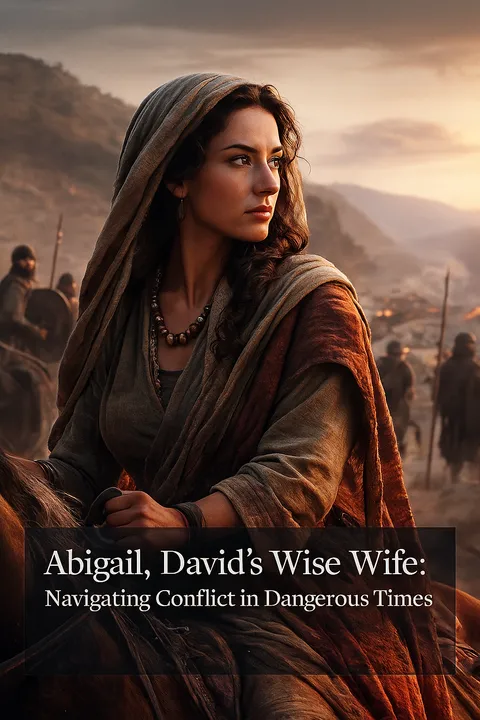
Abigail, David’s Wise Wife: A Profile in Wisdom, Peacemaking, and Survival in a Violent World
How one woman’s courage, discernment, and action stopped a massacre — and steadied a future king
Abigail stands as one of the most extraordinary women in scripture — not because she lived in ease or spiritual clarity, but because she learned to navigate a world that was feudal, violent, patriarchal, and unforgiving. Her wisdom shines not in ideal conditions but in a razor-thin space between two dangerous men: a volatile husband and a future king with a temper.
Her story resonates deeply with Latter-day Saints because it shows how God works through righteous individuals — especially women — to prevent violence and steady the hearts of powerful men. But it also reveals something else: righteousness in the ancient world required grit, strategy, timing, and courage.
Family and Background: A Good Woman in a Hard Household
Abigail lived in a household where wealth did not equal safety. Nabal was not simply rude — he was a man whose foolishness was socially dangerous:
He insulted a rising warlord (David).
He violated hospitality norms that held political weight.
He put his entire household at risk by provoking a retaliatory raid.
In the ancient tribal context, this wasn’t just “rude.” It was suicidal.
And Abigail? She is introduced as “a woman of good understanding,” which, in context, means far more than intellect. It means political discernment, social intelligence, and an ability to read danger faster than those around her. She lived with a reckless man whose decisions could get them all killed.
Her wisdom is not abstract. It is survival.
A Divine Role Within a Brutal System
Abigail’s actions only make sense when seen inside her cultural world:
No police.
No court of appeal.
Honor-based retaliation.
Wealth defended by personal militia.
When David’s armed men were humiliated, the expected response was violent reprisal. In that world, offense required action. To ignore the insult was to appear weak.
So Abigail acts. Not because she wants to disobey her husband. Not because she seeks David romantically. But because she alone has the clarity to see the deadly implications of Nabal’s words.
She steps into a man’s world of swords and honor and uses the only weapons available to her: speed, diplomacy, humility, and inspired persuasion.
The Turning Point: A Woman Alone Before a Vengeful Warlord
When Abigail rides out to meet David, she isn’t entering a polite conversation. She is:
A woman alone,
Coming before four hundred angry armed men,
Attempting to stop a blood-feud already in motion,
With no guarantee David will stop, listen, or respect her.
This is not delicate peacemaking. It is bold and risky.
Her speech is not simply poetic or deferential. It is brilliantly calibrated to the values of her culture:
She acknowledges David’s honor.
She reframes his vengeance as beneath his calling.
She invokes God’s purposes.
She provides a face-saving path to mercy.
She offers tribute that satisfies honor culture norms.
Her words “turn away wrath” not because they are pretty, but because they directly address the cultural mechanisms of violence. This is divine inspiration expressed as political skill.
Nabal’s Death and Abigail’s Marriage to David
When Nabal dies, the text frames it as God’s judgment — not David’s victory. But Abigail’s transition into David’s household must be understood in context:
David was already married (Michal and Ahinoam).
Polygamy was culturally normal in pre-Christ Israel.
Marriages functioned as alliances, protection, and political structure.
Abigail moved from a dangerous household to a safer one led by a man who respected her wisdom.
Her marriage is not romantic rescue. It is social elevation, political alignment, and physical security in a world without alternatives for widowed women of property.
Her righteousness stands distinct from David’s complicated marital life. Scripture never uses her story to justify or critique polygamy; it simply reflects the world she lived in.
A Moment of Divine Intervention Through Human Courage
The central truth of 1 Samuel 25 is this: God prevented violence — but He did it through Abigail.
David recognizes this. His response is not polite gratitude — it is the relief of a man who nearly did something he could never undo:
“Blessed be the LORD God of Israel, which sent thee this day to meet me… and blessed be thy advice, and blessed be thou, which hast kept me this day from coming to shed blood.”
This is not sentimental. This is a warrior thanking God for stopping him from becoming a mass murderer.
Abigail becomes a living example of God using:
A marginalized voice in a patriarchal world,
A woman who took action instead of complaining or criticizing without effect,
To redirect the future king of Israel away from the bloodguilt that would eventually stain his reign.
God did not send an angel. He sent a woman on a donkey with bread, wine, and the right words at the right moment.
Spiritual Principles in a Real Human World
Abigail embodies spiritual principles Latter-day Saints cherish — but she embodies them within a world of danger, politics, patriarchy, and violence. Her faith did not shield her from complexity; it empowered her to navigate it. She did not stand idly waiting for God to save her. Rather, she acted — doing that which she believed was required.
Wisdom: Not book learning, but the ability to read danger and act.
Peacemaking: Not passivity, but costly intervention.
Divine guidance: God working through human courage and strategic action.
The Lesson of Abigail
Abigail teaches that spiritual gifts — wisdom, discernment, and peacemaking — are not soft skills. They are survival skills. They are leadership skills. They are kingdom-building skills.