“This Is My Work and My Glory”
What Moses 1 and Abraham 3 Are Actually Saying
We often approach the opening of the Old Testament as though it begins with matter—with light, land, water, and sky. But the restored scriptures insist that it begins somewhere far more fundamental: with individuals, plans, covenants, and purposes.
Before the earth is formed, before days are counted, before dust is shaped into bodies, God reveals something essential—who He is, who we are, and why any of this exists at all.
Moses 1 and Abraham 3 are not side notes to Genesis. They are the interpretive key. Without them, the Creation story is easily flattened into either myth or mechanism. With them, it becomes a narrative about becoming, agency, and God’s eternal purpose.
God Begins with Identity, Not Instruction
When God first speaks to Moses, He does not give commandments. He does not explain cosmology. He does not issue a task list.
He establishes identity.
Moses 1:4
“Behold, thou art my son.”
Only after that does God describe His power, His creations, and His work. Identity comes first—because without it, power is terrifying, and obedience becomes hollow subservience.
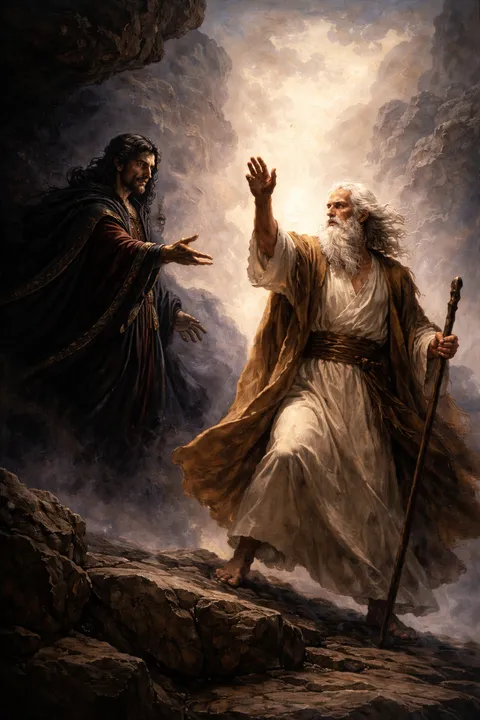
This pattern matters. When Satan appears moments later, his first move is not temptation in the conventional sense. He does not offer pleasure or advantage. He attempts identity erosion:
Moses 1:12
“Moses, son of man, worship me.”
God names Moses son of God. Satan reframes him as son of man.
This is not accidental. It is the same contest we live inside every day.
When we forget who we are, we become vulnerable to counterfeits—false authorities, false urgencies, false measures of worth. If Satan can confuse our identity, he can distort our eternal purpose. If he can undermine our understanding of our worth, he can assert his values and co-opt our conscience. The temptation is rarely overt evil. It is almost always misplaced allegiance.
Moses resists not because he feels strong, but because he remembers:
Moses 1:39
“I know that God loveth his children.”
That knowledge—not spectacle, not certainty, not emotion—is what ultimately drives Satan away.
The Vision Ends. The Test Begins.
One of the most overlooked details in Moses 1 is that God withdraws before Satan appears. Moses has just seen worlds without number. He has spoken face to face with God. And then—suddenly—he is alone. This is not a failure of the vision. It is the point of it.
The purpose of divine revelation is not to keep us perpetually shielded. It is to prepare us to act when heaven feels quiet—when memory replaces immediacy, when we are left to choose without constant reassurance. Moses does not defeat Satan by demanding proof or calling down power. He acts in remembered covenant language. He prays. He waits. He stands his ground. That is mortal life in miniature.
We are not meant to live constantly in spiritual clarity. We are meant to act faithfully after clarity recedes—when we do not know, when paradox stands before us.
Creation Is Not the Goal—Exaltation Is
When Moses asks the question most of us would ask—
Moses 1:30
“Tell me… why these things are so.”
God’s answer is startling in its simplicity:
Moses 1:39
“This is my work and my glory—to bring to pass the immortality and eternal life of man.”
Creation is not God’s glory. Power is not God’s glory. Even salvation, narrowly defined, is not God’s glory.
The transformation of His children is.
Immortality—the reunion of spirit and body—is given to all through Jesus Christ. Eternal life—a life like God’s—is something we grow into through covenant, agency, refinement, and ultimately through the Atonement of Him who is mighty to save.
This distinction matters.
A theology that reduces eternal life into mere survival—or into a single moment of confession—will inevitably reduce obedience to compliance and grace to mere pardon. Moses 1 refuses that reduction. God is not merely preserving lives; He is forming persons.
We Lived Before We Were Born—and That Changes Everything
Abraham 3 quietly shifts the entire moral framework of existence:
Abraham 3:22
“Now the Lord had shown unto me… the intelligences that were organized before the world was.”
This is not poetic language. It is an ontological claim.
You did not begin at birth. You were not created as a moral blank slate. You were known, seen, and recognized before mortality.
And importantly:
Abraham 3:23
“These I will make my rulers.”
This is often misunderstood as favoritism. It is not. Foreordination is not a guarantee of outcome. It is a calling to responsibility. Those described as “noble and great” are not shielded from suffering; they are entrusted with heavier burdens. Leadership, in this framework, is not privilege—it is exposure to greater cost. If your path feels weighty rather than easy, costly rather than comfortable, that may not be evidence of failure. It may be evidence of assignment.
The War in Heaven Was About Agency, Not Obedience
When God presents the plan—
Abraham 3:27
“Whom shall I send?”
—two responses emerge.
Christ honors agency and accepts uncertainty: “Here am I, send me.”
Lucifer offers guaranteed outcomes at the cost of freedom: “I will redeem all mankind… wherefore give me thine honor.”
This conflict is not ancient history. It repeats wherever control is mistaken for righteousness—in parenting that coerces rather than teaches, in religion that values compliance over conversion, in systems that promise safety by removing choice. God consistently chooses risk with agency over control with certainty.
That should give us pause when we are tempted to do otherwise.
Mortal Life Is a Continuation, Not a Punishment
Abraham 3:25
“We will prove them herewith, to see if they will do all things whatsoever the Lord their God shall command them.”
This is not a trap. It is not a test designed for failure. It is an environment where growth becomes possible because choice carries consequence.
Earth is not where worth is determined. It is where character is revealed, proven, and refined.
The End Goal: Becoming Like Christ
Is Jesus Christ God? Yes. Has He been given the fullness of the Father’s power and dominion? Yes. And the restored scriptures go further: they teach that what Christ has received is something humanity is capable of receiving through Him.
Scripture testifies that Christ has received all power and glory (Matthew 28:18; John 17:2; Romans 1:16). It also testifies that mankind, through Christ, may become heirs of that same inheritance (Romans 8:17; Revelation 3:21; Revelation 21:7).
We are called sons and heirs, not servants alone (Galatians 4:7). We are promised transformation, not mere survival (1 John 3:2). We are commanded to become, not merely behave (Matthew 5:48).
This is not blasphemy. It is covenant theology.
What This Doctrine Asks of Us
Moses 1 and Abraham 3 do not ask for passive belief. They ask for ownership. These chapters establish the truths that:
Your life is not accidental
Your struggles are not meaningless
Your agency is sacred
Your growth matters more than your comfort
God is not merely watching to judge outcomes. He is invested in who you are becoming. That understanding does not simplify life. But it makes life intelligible.
And perhaps that is the greatest mercy of all.