
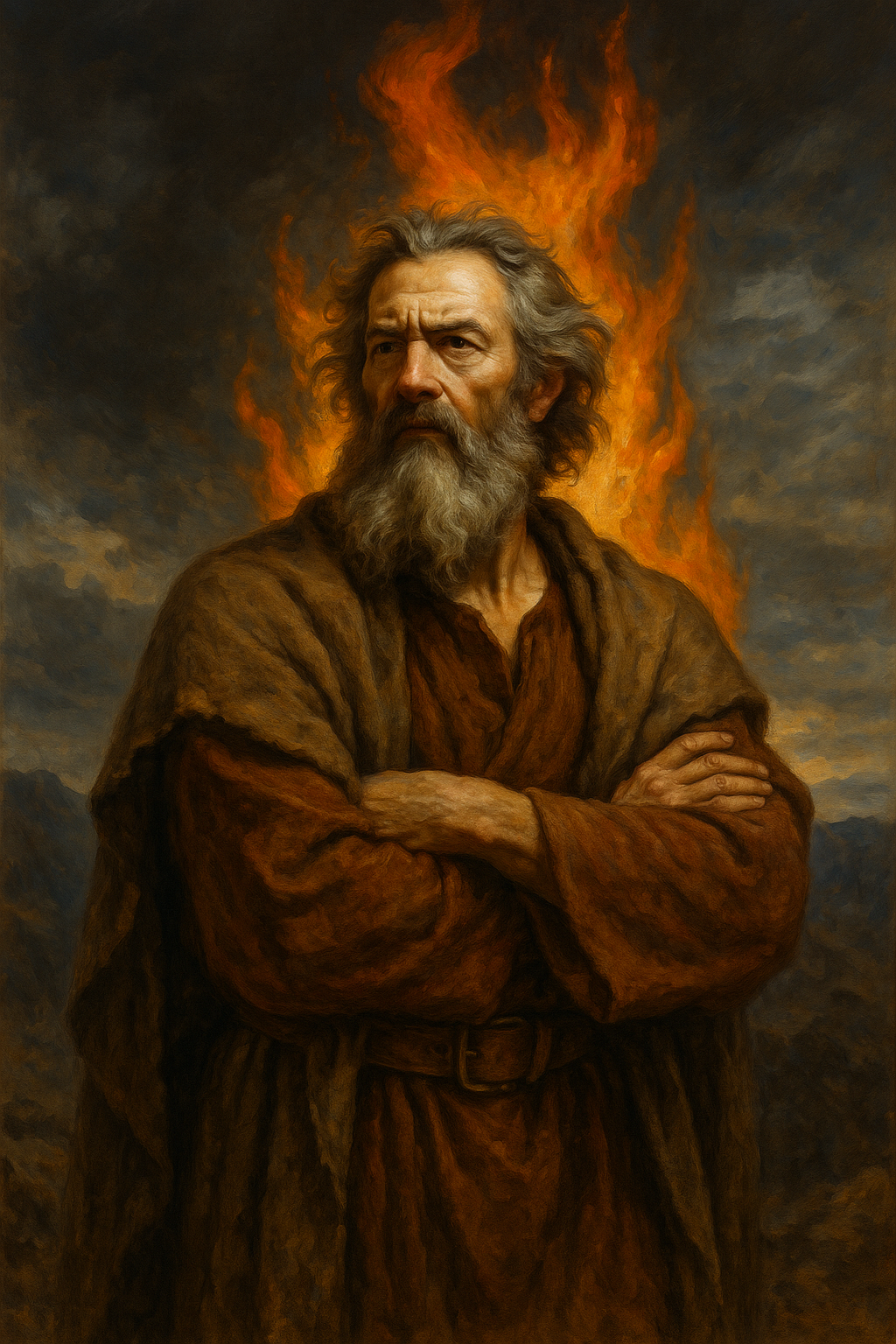
Elijah the Tishbite: A Prophet Formed by Fire, Stillness, and Divine Authority
Authority does not rise upward through systems, consensus, or government. It descends from heaven to those whom God commissions.
Elijah the Tishbite enters the scriptural record without genealogy or institutional support. He appears suddenly before King Ahab—not as a court prophet or religious reformer, but as an authorized servant of the living God—standing alone in public authority amid the systematic persecution of the Lord’s prophets—and declares a drought so complete that rain will fall only by his word (1 Kings 17:1). In a culture devoted to Baal, the supposed storm god, this declaration is not merely predictive. It is a direct challenge to a religious system claiming authority it does not possess.
Then Elijah disappears. Not into honor. Not under the protection of Israel. Instead, the Lord removes him from the presence of both government and people and sustains him in isolation, feeding him by ravens beside the brook Cherith (1 Kings 17:2–6). This detail is not ornamental. Israel does not sustain Elijah. God does.
From the outset, Elijah’s life demonstrates that prophetic authority does not depend on popularity, institutional backing, or collective affirmation. God is fully capable of sustaining His servants when His people fail to do so (cf. D&C 1:38). Authority descends from heaven to those whom God commissions to speak and act in His name (D&C 121:36–37).
Fire, Fraud, and the Exposure of False Power
When Elijah returns, Israel is spiritually divided. Jezebel has institutionalized Baal worship, and throughout the drought the prophets of the Lord have been hunted and killed, forcing those who remain into hiding (1 Kings 18:4, 19). The people waver—neither fully faithful nor openly defiant—attempting to balance covenant obligation with cultural convenience.
Mount Carmel becomes the site of confrontation (1 Kings 18:20–21). Religious deception was not uncommon in the ancient world. Altars could be constructed to conceal embers or ignition points, allowing priests to simulate divine fire. Such fraud depended on preparation, secrecy, and control. Elijah exposes the pattern deliberately.
He grants the prophets of Baal every advantage: superior numbers, unrestricted ritual practice, ample time, and favorable conditions (1 Kings 18:25–29). If false power can succeed, it will do so here. It does not. Their cries, self-inflicted wounds, and ritual excess expose the emptiness of manufactured authority. The enthusiasm of frenzy is mocked by the stillness of revelation given directly to the prophet of the Living God.
First, he mocks their claims of sanctity. Then, amid a prolonged drought—when water itself is scarce—he commands that water be poured repeatedly upon the sacrifice, the wood, the altar, and into the surrounding trench (1 Kings 18:33–35). Every plausible mechanism of deception is removed. No ember can survive. No manipulation remains.
When the fire falls, it consumes not only the offering and the wood, but the stones, the dust, and the water itself (1 Kings 18:38). Nothing is preserved. Human deception requires concealment. Divine power leaves nothing to be staged or repeated.
The people cry, “The Lord, he is the God” (1 Kings 18:39). Yet recognition is not repentance. Miracles reveal truth, but they do not compel covenant loyalty. Knowledge of truth does not, by itself, produce obedience.
Victory Without Applause
The fire does not soften Jezebel. Truth exposed does not persuade those whose power depends on deception. Enraged by the loss of her priests, she vows Elijah’s death (1 Kings 19:1–2). Her response confirms the lesson of Carmel: knowledge of the truth does not guarantee obedience to it.
Elijah does not flee in cowardice, but in exhaustion. Triumph does not dissolve grief. Authority does not insulate against despair. The man who called down fire from heaven collapses beneath a juniper tree and asks to die—overwhelmed by isolation and a sobering reality: even unmistakable, empirical evidence does not compel people to do what they know is right (1 Kings 19:4).
He retreats to Mount Horeb. Elijah expects another demonstration of power—wind, earthquake, and fire (1 Kings 19:11–12). God is present in none of these. Instead comes a still, small voice—recognized by one accustomed to hearing the word of the Lord.
Not because God lacks power, but because transformation is not produced by compulsion. Fire commands attention. Obedience requires consent. Truth may be perceived and yet rejected; authority may be recognized and yet resisted. Elijah learns that divine authority is not synonymous with spectacle. God confronts, but He also steadies. He reveals, but He also sustains.
Rain, Restoration, and Enduring Power
After the fire, rain follows—not by command, but through persistent petition. Elijah prays, sending his servant repeatedly to look toward the sea until a sign appears (1 Kings 18:42–44). The response is not immediate, dramatic, or overwhelming. It is sufficient.
The sequence matters. Fire exposes false authority; rain restores what judgment has removed. Both occur according to God’s will and timing, confirming that divine power operates on heaven’s terms—not human demand or ritual manipulation (cf. Ether 12:6).
Authority That Binds
Elijah’s ministry moves between opposites: fire and stillness, confrontation and collapse, isolation and reassurance. Through these tensions, a deeper truth emerges. Divine authority is not merely the power to act, but the authority to bind. It is not seized by governments, acquired through learning, or conferred by possession of the Torah or any secular mechanism. It is given by God to those He commissions and exercised through obedience to His voice—often quiet, always sovereign.
This is why Elijah does not taste death. He is taken into heaven (2 Kings 2:11), not as escape, but because his work is unfinished. The authority entrusted to him remains necessary beyond his mortal ministry.
Centuries later, Elijah returns in the Kirtland Temple to restore the sealing keys—the authority to bind on earth and in heaven (D&C 110:13–16)—fulfilling the promise spoken by Malachi (Malachi 4:5–6; D&C 2:1–3). The power that once consumed altars now binds families.
Conclusion
Elijah the Tishbite shows that God’s servants are formed through both power and restraint, revelation and quiet obedience. His life testifies that divine authority cannot be fabricated, multiplied by numbers, or sustained by institutions alone. Those whom God authorizes are upheld by heaven—even when isolated, resisted, or unseen.
God may answer through power, through provision, or through quiet instruction. But He always answers according to His authority, not human demand—because knowledge alone never guarantees obedience—and always in preparation for Christ, in whom all authority is held.