
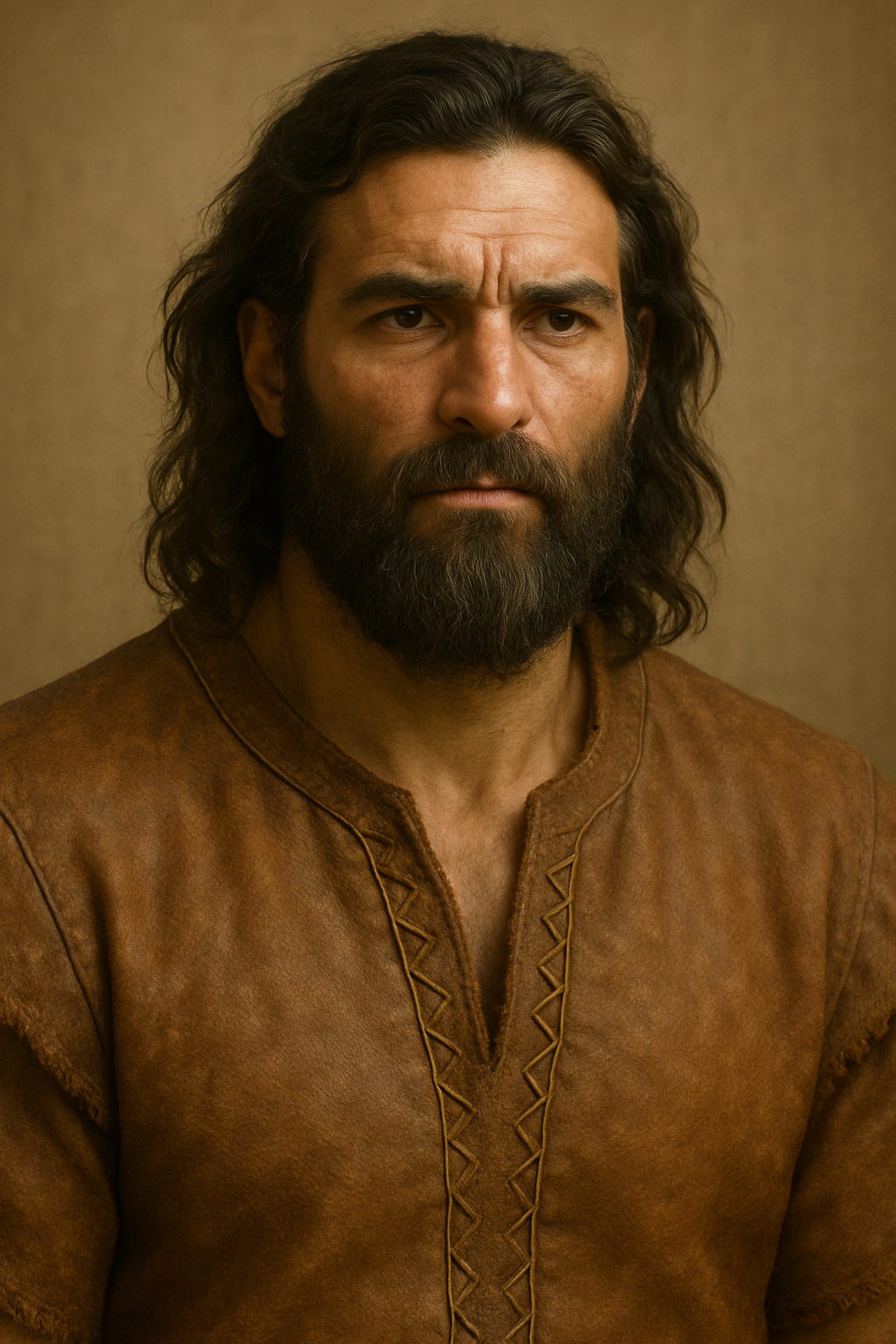
Adam: The First Man, Covenant Father, and Witness of Christ
Archangel, patriarch, and first steward — whose testimony of Christ anchors all of human history
Adam enters the scriptural narrative not as a mythic figure or symbolic construction, but as an actual, embodied son of God — created, instructed, and placed under covenant directly by the Lord (Genesis 1–2; Moses 3). His life is not represented as emerging from tribal memory or legend. It is presented plainly: God formed man, gave him law, placed him in stewardship over the earth, and established the first marriage and the first covenant family (Genesis 2:7, 18–24; Moses 3:7–25).
Though Adam is introduced plainly as the first man, the mechanism of his creation is not explained in scripture. God formed him — this is stated clearly — but how that formation occurred is not. The same is true of the earth itself: its organization, timing, and physical processes are described only at the level necessary for covenant understanding, not scientific detail. The Lord has revealed purpose, identity, and relationship, but the physical processes by which Adam’s body was created remain shrouded in mystery, known fully only to God. Scripture does not elaborate, and modern prophets have consistently taught that the precise manner of creation has not been revealed.
Adam is also Michael the Archangel, a title that reflects authority held long before his mortal life. Modern revelation makes clear that he presided in the councils of heaven and played a direct role in the creation of the earth under the direction of Jesus Christ (D&C 27:11; D&C 107:53–54; Abraham 3:24–27). His stewardship did not begin in Eden. He held keys, responsibility, and leadership in premortality, and he entered mortality already bearing the authority God had appointed to him from the beginning. His later roles — prophet, patriarch, archangel, and presiding high priest — are continuations of that same divine commission.
A Life Shaped by Command, Choice, and Covenant
Adam’s story begins with clarity. God commands, instructs, and warns (Genesis 2:16–17). There is no hidden symbolism. The Lord establishes the pattern that will govern all divine relationships thereafter:
- God reveals His will.
- Humanity must choose.
- Consequences follow — not as arbitrary punishments, but as part of the covenant structure of agency and as the natural result of divine law.
Adam’s transgression is not framed as rebellion but as the deliberate step into mortality required for the human family to progress (Moses 5:11; 2 Nephi 2:22–25). Mortality brings profound blessing and profound suffering. Adam enters a world defined by thorns, sweat, labor, sickness, and death (Genesis 3:17–19). He experiences the sorrow of wayward children, the pain of human conflict, and the weight of stewardship in a fallen world.
Yet Adam does not resent mortality. He rejoices in it. He declares that through this experience he will “see God,” gain knowledge of good and evil, and know the joy of redemption through the Only Begotten (Moses 5:10). His life demonstrates that suffering is not a contradiction to God’s plan, but a vital part of learning, agency, accountability, and becoming.
The First Priesthood Holder
After the Fall, Adam does not navigate mortality alone. The Lord teaches him the gospel directly (Moses 5:4–12). Adam receives commandments, ordinances, and priesthood authority long before organized religion, tribes, or nations form. This demonstrates a doctrinal truth echoed throughout scripture:
Priesthood authority originates from God, not culture, lineage, or human tradition.
Adam offers sacrifice at God’s command (Moses 5:5). He learns that these ordinances point to Christ. Angels minister to him. The Holy Ghost falls upon him. Revelation is direct, practical, and continuous.
Through this, Adam becomes the prototype for all prophets: he receives commandments, revelation, priesthood, and covenant directly from the Lord — and then teaches what he receives to his family.
A Father Who Teaches Truth Amid Apostasy
Adam’s family does not remain unified in the gospel. His children divide sharply between obedience and rebellion. Cain rejects God’s commandment, enters into covenant with Satan, and murders Abel (Moses 5:16–35). This is the first recorded apostasy from priesthood truth — occurring within a generation of Eden.
Yet Adam continues teaching the gospel despite widespread rejection among his posterity (Moses 5:12, 58). His ministry demonstrates that truth is not validated by majority acceptance. Revelation stands independent of culture, numbers, or resistance — and the choices of a parent’s children are not the responsibility of a parent who has taught them better.
Adam-ondi-Ahman: Stewardship and Judgment
The prophetic significance of Adam stretches far beyond his mortal ministry. Latter-day Saints understand Adam’s ongoing role through modern revelation:
- Adam is Michael, the archangel (D&C 27:11; D&C 88:112).
- He will preside at Adam-ondi-Ahman, a future gathering where keys are returned to Christ (D&C 116).
- He holds presidency over all dispensations and all of humanity.
This is not metaphor — these are historical facts and prophetic truths. It is also a priesthood structure. Adam was the first steward over the earth, and he will participate in the final return of authority to Christ before His coming.
A Witness of Christ
Adam’s life — creation, fall, suffering, labor, revelation, and priesthood — centers on the mission of Jesus Christ. His own recorded testimony is unambiguous:
- He rejoices that he will “see God.”
- He rejoices that “in my flesh I shall see God.”
- He rejoices that the Fall made possible redemption.
- He rejoices that through Christ, “we shall be brought back into the presence of God” (Moses 5:10–11).
This is not theoretical. Adam’s entire mortal experience — its sorrow, labor, consequences, and learning — is interpreted by him through the lens of Christ’s Atonement and how it directly applies to individuals, families, and nations.
Not a Passive Figure, but a Deliberate Leader
Adam’s life shows intentionality, responsibility, and endurance:
- He enters mortality knowingly.
- He accepts responsibility for his posterity.
- He willingly experiences the suffering inherent to mortality.
- He administers priesthood ordinances.
- He teaches truth in the face of rebellion.
- He bears testimony of Christ when the significance of mortality becomes clear to him.
His life demonstrates that spiritual leadership and parental responsibility are not defined by comfort or ease. They are defined by obedience, sacrifice, and a willingness to experience mortality with faith and gratitude.
Adam’s Testimony Still Stands
Adam is not merely the first man chronologically; he is the first man theologically. His life establishes the doctrines of agency, opposition, suffering, priesthood, revelation, ordinance, and redemption. Through him we see:
- Mortality as a sacred opportunity, not a mistake
- Suffering as part of the necessary experience of learning good from evil
- Priesthood authority given directly by God
- The gospel taught from the very beginning
- The Atonement of Jesus Christ as the center of the plan
Adam’s own testimony anchors the entire narrative:
“Blessed be the name of God, for because of my transgression my eyes are opened… and in this life I shall have joy, and again in the flesh I shall see God.”
Adam understood the plan. He lived it with faith. And he rejoiced in Christ.
Scriptural References
LDS Standard Works
- D&C 27:11 — Identifies Adam as “Michael,” the archangel
- D&C 107:53–56 — Adam presides over the patriarchs and gives them his final blessing
- D&C 116 — Reveals the location and future purpose of Adam-ondi-Ahman
- D&C 138:38 — Adam (Michael) as a leader among premortal spirits
- Abraham 3:22–28 — Noble and great premortal spirits in the Council in Heaven
- Moses 5:4–12 — Adam receives commandments, priesthood ordinances, angelic instruction, and bears testimony of the plan of redemption
Ancient Texts & External References
The following sources provide historical, apocryphal, and scholarly context for ancient traditions relating to Adam, Michael, and premortal leadership.
Apocryphal Adam Traditions
- Life of Adam and Eve (Vita Adae et Evae, Latin) — Accounts of Adam’s repentance, visions, angelic instruction, and dialogue with heavenly beings
- Vita Adae et Evae (English Translation) — Modern-English translation with narrative details about Adam’s interactions with angels
- Apocalypsis Mosis (Apocalypse of Moses) — Greek Adam and Eve tradition, including angels ministering to Adam and the account of his death and burial
- R. H. Charles, trans. “Apocalypse of Moses” — Classic translation containing descriptions of Michael and other angels assisting Adam
- The Book of Adam and Eve (Conflict of Adam and Eve with Satan) — Ethiopic tradition narrating Adam and Eve’s life after Eden
Michael and Adam in Jewish Tradition
- Jewish Encyclopedia — “Michael” — Traditional Jewish material where Michael participates in Adam’s creation and assists him after the Fall
- Ginzberg, Louis — Legends of the Jews — Rabbinic legends including accounts of Michael preparing Adam’s body and ministering to him
- Syri.ac — Old Testament Pseudepigrapha Index — Scholarly summaries and links to pseudepigraphal works relating to Adam, Eve, and early biblical figures
- “Michael the Great Prince and Saviour of Israel” — Survey of early Jewish and Christian references to Michael’s roles in scripture and tradition
Kabbalistic & Early Christian Sources
- Chabad.org — “Chaos and the Primordial: Adam Kadmon” — The kabbalistic concept of Adam Kadmon as a primordial, heavenly figure in Jewish mysticism
- Wikipedia — Adam Kadmon — The mystical tradition of a primordial “heavenly Adam” within Kabbalah
- Origen — On First Principles — Early Christian theological work discussing the pre-existence of rational beings
- Wikipedia — Michael (archangel) — Overview of roles attributed to Michael in Jewish and Christian sources