
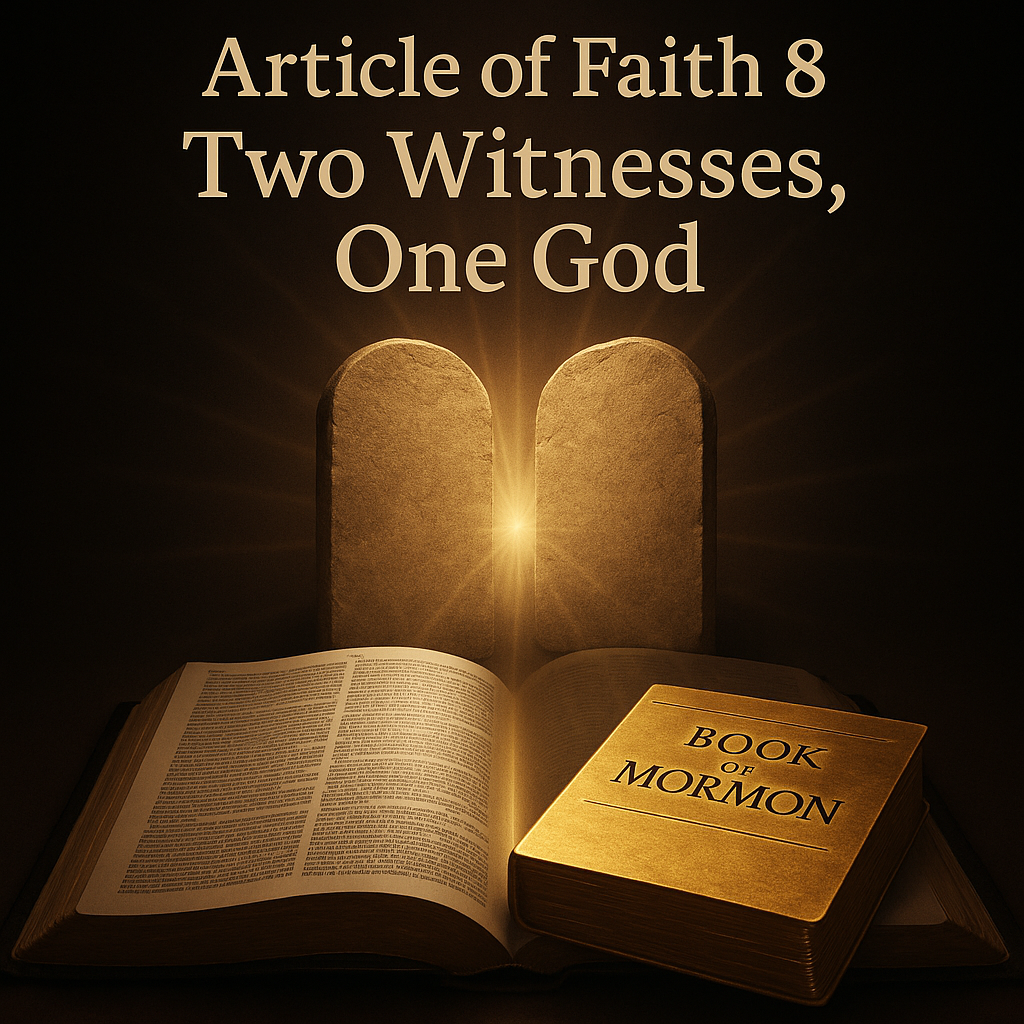
Article of Faith 8 – Two Witnesses, One God
“We believe the Bible to be the word of God as far as it is translated correctly; we also believe the Book of Mormon to be the word of God.”
The atheist raises The Fabrication Argument: “You say you believe the Bible ‘as far as it is translated correctly’ — that’s a convenient escape clause. And the Book of Mormon? A 19th-century novel written by a convicted con man. Why trust either when both are filled with contradictions, violence, and moral confusion?”
The Protestant emphasizes The Closed Canon Argument: “The Bible is complete. Revelation ended with the apostles. God’s word needs no second witness. The Book of Mormon adds to scripture and therefore contradicts it, violating the command: ‘If any man shall add unto these things, God shall add unto him the plagues…’ (Rev. 22:18).”
The ex-LDS gives The Authenticity Argument: “I read the Book of Mormon with sincerity — and found 19th-century phrasing, copied Bible passages, and no archaeological support. It moved me emotionally once, but that doesn’t make it true.”
1. To the Atheist: “Fabrication?”
If scripture is all fabrication, then explain the world it built. No empire, philosophy, or science has shaped civilization like the Bible. The atheist scoffs at “translation errors,” yet trusts scientists who revise their theories with each discovery. Translation is not corruption — it is transparency. The very phrase “as far as it is translated correctly” is not an escape; it is intellectual honesty, admitting that human hands can blur divine speech.
And the Book of Mormon? It does not compete with the Bible; it confirms it. Its message is Christ’s — the same Redeemer, the same call to repentance, the same promise of resurrection. A forger gains power by contradiction; Joseph gained none. He died for his testimony. Falsehoods collapse under persecution; truth endures it.
2. To the Protestant: “The Closed Canon”
Revelation 22:18 warns against corrupting the book of Revelation — not against God ever speaking again. Moses warned similarly in Deuteronomy 4:2, yet centuries of prophets followed him. If God was allowed to speak after Moses, He can speak after John. To declare that heaven has gone silent is to declare that God is dead.
The Bible itself points beyond its own pages: Christ promised “other sheep” who would hear His voice (John 10:16). The Book of Mormon records that voice among another branch of Israel. Its purpose is not to replace the Bible, but to confirm it — “that Jew and Gentile, all nations, kindreds, tongues, and people may be brought to the knowledge of the Lord” (1 Nephi 13:40).
Two witnesses establish truth (Deut. 19:15). God gave the world not one but two — the Bible and the Book of Mormon — that His word might stand sure.
3. To the Ex-LDS: “Authenticity?”
The KJV-overlap argument assumes the Book of Mormon quotes the same Hebrew base text used for the KJV (Masoretic). It doesn’t. By its own claim, Nephi’s Brass Plates were a separate Hebrew autograph around 600 BC. In multiple places, the Book of Mormon’s Isaiah agrees with ancient non-Masoretic witnesses — the Dead Sea Scrolls and Septuagint — against the KJV. That’s what you’d expect if it reflects a different upstream source (e.g., 2 Nephi 12:11 // Isa 2:11; 2 Nephi 19:3 // Isa 9:3; Mosiah 14 // Isa 53).
The KJV cadence is translation strategy, not plagiarism. The Book of Mormon restores Hebraic poetic structure (parallelism, chiasm, epistrophe). Even its language claim — “learning of the Jews and the language of the Egyptians” — fits ancient scribal practice. Hieratic and demotic were both “reformed Egyptian” forms used in Hebrew-speaking cultures.
Bottom line: Surface similarity is not source dependency. The Book of Mormon behaves like a record with its own root — sometimes preserving older, better Isaiah than the Bible itself. That is not plagiarism; that is providence.
4. To the Latter-day Saint: “The truth is evident.”
You have read the Bible and the Book of Mormon together and found harmony, not discord. You have heard Christ’s voice in both — one from the old world, one from the new — confirming that He speaks still. You know the Book of Mormon is not a replacement but a second witness. And you know the Spirit that confirms it is the same Spirit that spoke to prophets ancient and modern.
The Irrefutable Core
- The atheist must see that the world’s most transformative book cannot be reduced to myth — and that “translation” does not mean fabrication.
- The Protestant must see that a closed canon is a man-made fence around a God who still speaks.
- The ex-LDS must see that familiarity and culture do not invalidate divinity — that the Book of Mormon’s power is its proof.
- The LDS know firsthand that the Bible and Book of Mormon together bear united witness of Jesus Christ.
The Bible and the Book of Mormon are not rivals but companions — two testaments, two lands, one Redeemer. This is why we believe Article of Faith 8. Because without continuing revelation, faith is trapped in the past. With it, the word of God lives and breathes still.
Commentary: Can a Book Be a Witness?
Some have claimed that a book can’t be a witness, or that there is no evidence that a Nephi or Lehi existed. The idea that a “book can’t be a witness” is simply false. We treat records as witnesses every day—historically, legally, and scripturally. The Bible itself says the scriptures testify. Courts admit ancient documents as evidence. A written record does not cease to be a witness simply because ink carried the memory instead of a living tongue.
The Book of Mormon does not merely “contain stories.” It contains sworn public testimonies from identifiable men who saw and handled plates—men who stood by their statements under intense pressure, estrangement, accusation, and lifelong scrutiny. You may choose to disbelieve them, but pretending those witnesses don’t exist is intellectually dishonest.
Then there’s the tired assertion: “There’s no evidence Nephi or Lehi existed.” If that’s your standard, be prepared to abandon most of antiquity. There is no verified grave of Plato. No authenticated personal artifact of his from his lifetime. Everything we “know” about him is preserved through texts and transmission from later generations. The same is true for Homer, for Pythagoras, for Aesop, and for countless respected figures in ancient history. We accept them because the documentary evidence, internal consistency, cultural context, and transmission through time lead reasonable minds to conclude they were real, or at minimum highly plausible. That is how history works.
The Book of Mormon contains verifiable ancient literary structures, Old World place correspondences like Nahom/NHM and the eastward turn to a fertile Arabian coast that was not mapped in Joseph’s day, and a set of sworn witnesses whose testimonies remain on record to this day.
Reject it if you want. Faith is a choice, and disbelief is too. But let’s not pretend the dismissal is based on some airtight historical principle. The real argument isn’t “there’s no evidence.” The real argument is, “I don’t believe the evidence,” or perhaps more honestly, “I don’t want to.” That’s fine. Just don’t cloak preference in the language of certainty.
If you apply a fair standard—not a selectively convenient one—the Book of Mormon sits on the same epistemic shelf as most of ancient history: supported by witness, record, geography, and transmission. Belief remains your choice, but fiction is not the inevitable conclusion. It’s simply the conclusion you walked in with.
Another Response: This argument falls apart the moment you hold it to a consistent standard. Yes, the Bible has archaeological support for its civilizational setting. And guess what? None of that proves Adam and Eve, or a global Flood, or Jesus rising from the dead. We don’t have archaeological evidence of Eden. We don’t have an ark sitting on a hillside with Noah’s initials carved into the mast. We don’t have a stone inscription saying, “By the way, Christ resurrected—signed, Pilate.”
So if your requirement for the Book of Mormon is “show me GPS coordinates for every city and physical proof of supernatural events,” then you need to apply that same standard to the Bible. But you don’t—because you know perfectly well that ancient scripture doesn’t work like that.
Yet like it or not, the Book of Mormon has meaningful data points too: it gives an Old World route with a named location—Nahom/NHM—right where archaeology later bore it out. It describes turning east from that region toward a fertile coastal location with timber and fruit—a real-world anomaly in Arabia. It uses Hebraic literary structures like chiasmus that Joseph Smith did not invent. Stylometry indicates multiple authorship patterns, not a single 1820s voice.
The issue here isn’t evidence—it’s selective skepticism. When you like the text, you accept contextual evidence, textual analysis, witness accounts, and coherent transmission as valid. When you don’t like the text, suddenly the standard becomes “prove everything with archaeology or it’s fake.” That’s not scholarship. That’s bias dressed up as certainty.
You don’t have to believe the Book of Mormon. But don’t pretend your dismissal is based on some rigorous evidentiary principle. Because if you applied that same demand to the Bible, you’d have to throw half of it out too—and you know it.